 →
→ 

How to Build a Sourdough Starter from Scratch
 By Alexandra Stafford
—
Last Updated: 05/30/2026
By Alexandra Stafford
—
Last Updated: 05/30/2026
This post may contain affiliate links. Please read my disclosure policy.
This post outlines how to build a sourdough starter from scratch simply and quickly. In less than a week, with minimal effort, you will have a bubbly, active starter on your hands to use in all your favorite sourdough recipes.
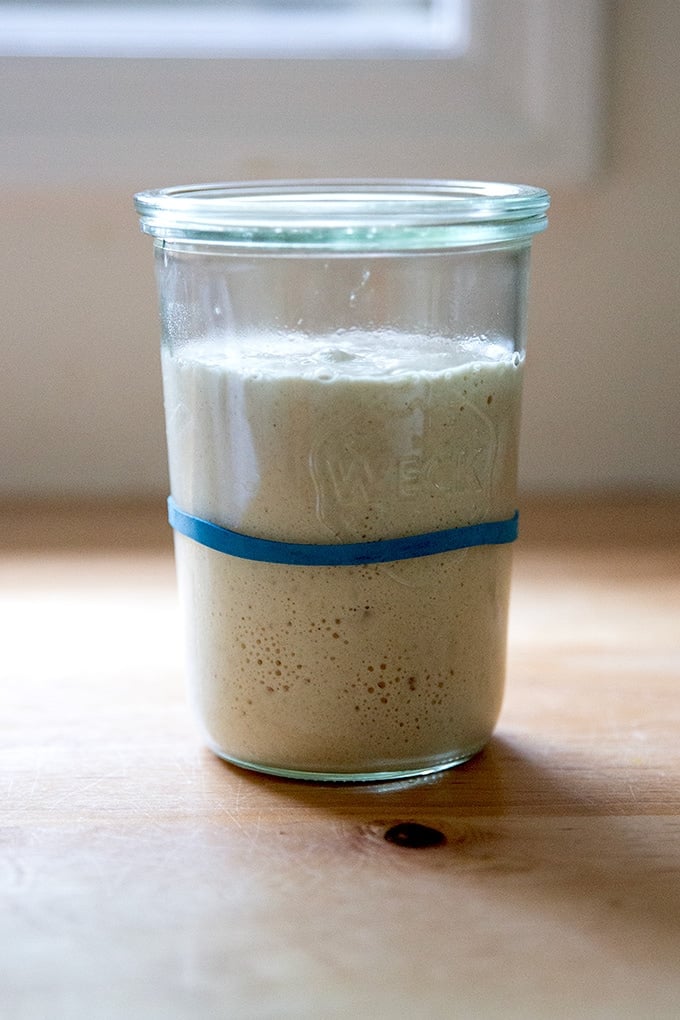
A sourdough starter is a fermented mixture of flour and water that contains wild yeast and bacteria. It both leavens and flavors sourdough bread.
How? It’s time for a science lesson.
Wild yeasts and bacteria exist everywhere, namely in flour, but also in the air and on your hands. When we mix flour and water and let it sit, wild yeasts begin searching for food, which they find in the flour: they convert the starch in the flour into sugar. As they digest this sugar, they produce two things: carbon dioxide, which makes the starter rise, and alcohol, which the wild bacteria drink up and in turn produce various types of lactic and acetic acids — these acids are what give the bread the sour flavor.
Cool, right? The wild yeasts and bacteria work symbiotically to both leaven and flavor our starter and ultimately our bread.
3 Tips For Success
Because wild yeast and bacteria are the backbone of a sourdough starter, it is crucial that these microbes are happy for your starter to thrive: the happier they are, the more they multiply, the more powerful the starter you create.
Building up a colony of happy microbes takes time and care. Here are three tips for success:
Tip #1: Use Good Flour: Use freshly milled, stone-milled flour because the added minerals and nutrients provide better food for the microbes (yeast and bacteria) to thrive. If you have a local source, use it! Health food markets, co-ops, and stores like Whole Foods often carry freshly milled flour. See recipe box for a few online sources I love. Stone-Milled Flour = Rocket Fuel For Your Starter
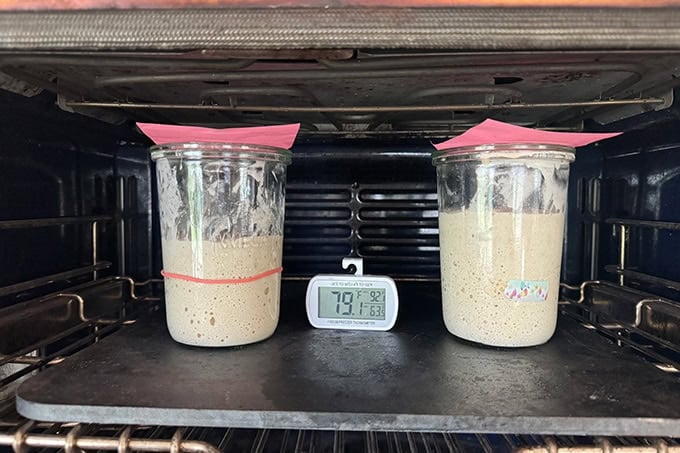
Tip #2: Keep Your Starter Cozy: Ideally, you’ll attempt this project while it’s hot outside — I find 80ºF (26ºC) to be ideal. If you’re building your starter when it’s cold outside, find a place to keep it warm. See recipe box for some ideas. Invest in a reasonably priced ambient temperature thermometer to help you monitor the various warm environments you create:
Tip #3: Use Pineapple Juice: Using pineapple juice in place of water initially can shorten the overall timeline for building a sourdough starter from scratch. This is because wild yeast cells prefer a somewhat acidic pH (which pineapple juice is) in which to grow.
How to Build a Sourdough Starter From Scratch, Step by Step
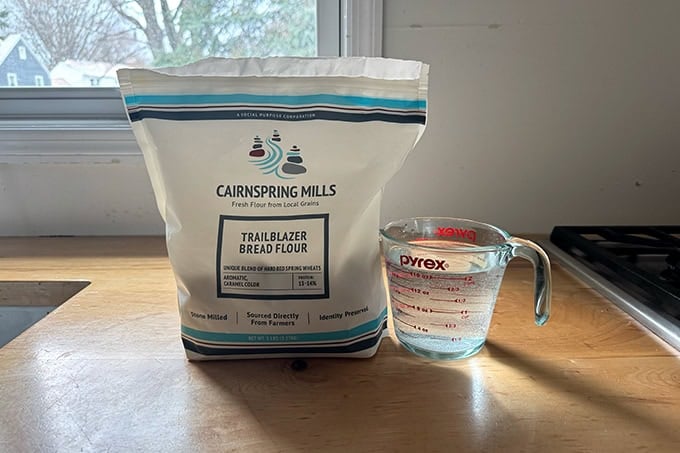
Day 1: Gather your materials: good stone-milled flour and water or…
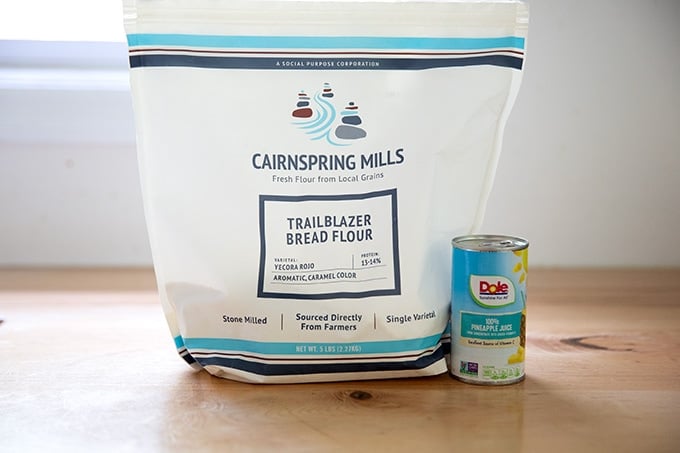
… flour and pineapple juice:
Pour the water or juice into a large bowl or, ideally, a straight-sided vessel on a tared scale.
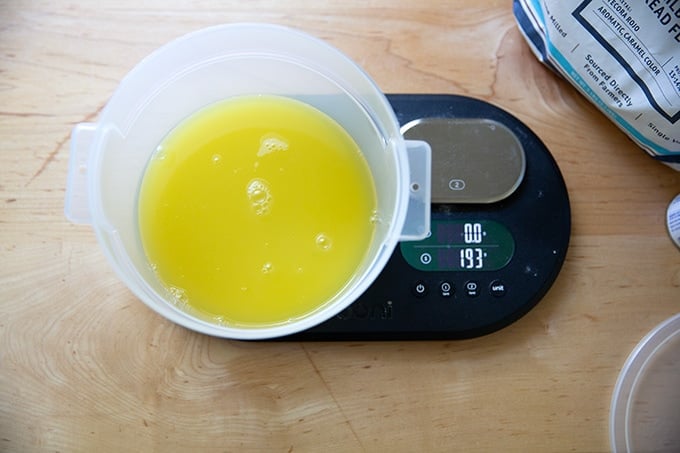
Add an equal amount of flour by weight. It should be about 192-193 grams of each.
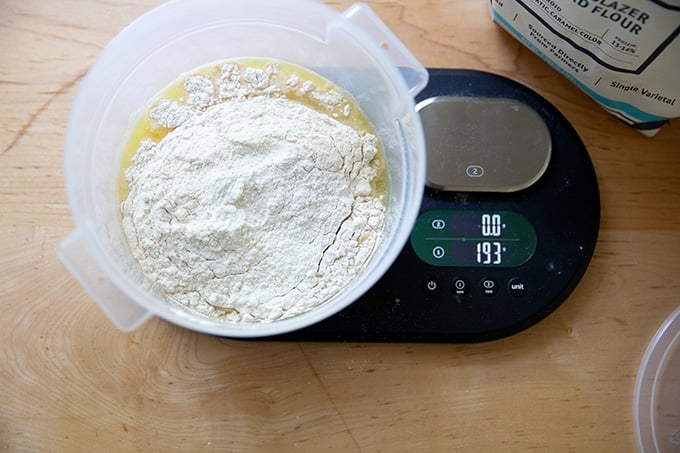
Stir until the flour is absorbed.
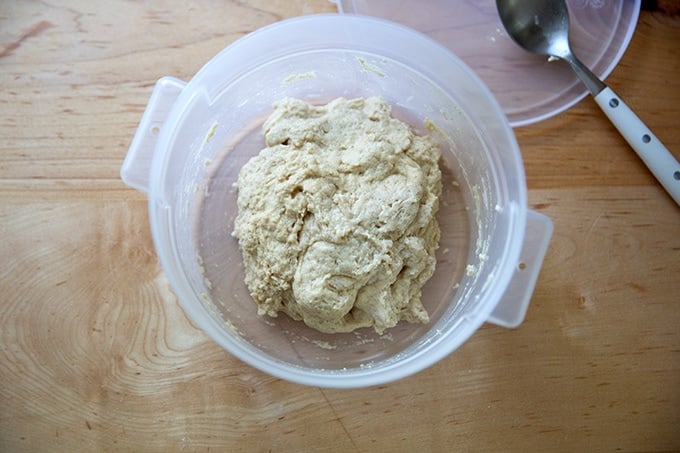
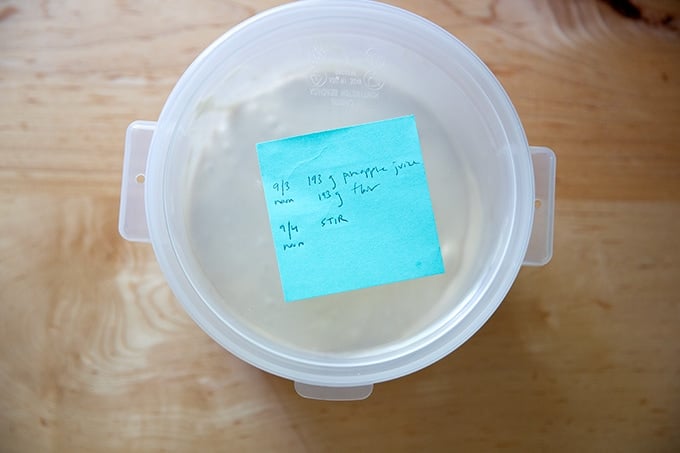
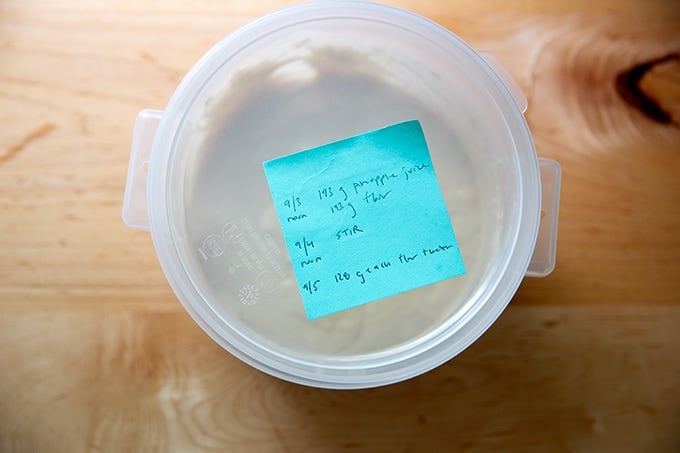
Cover the vessel. Record the date, time, and measurements — you will forget which day you started if you don’t. Let it sit at room temperature for 24 hours.
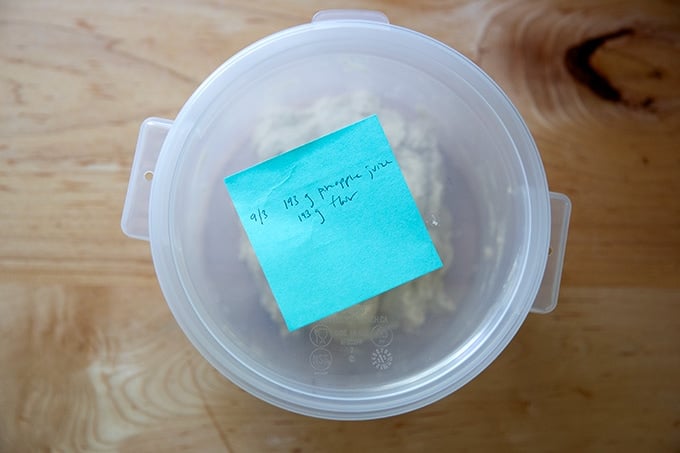
Day 2: Uncover the vessel and…
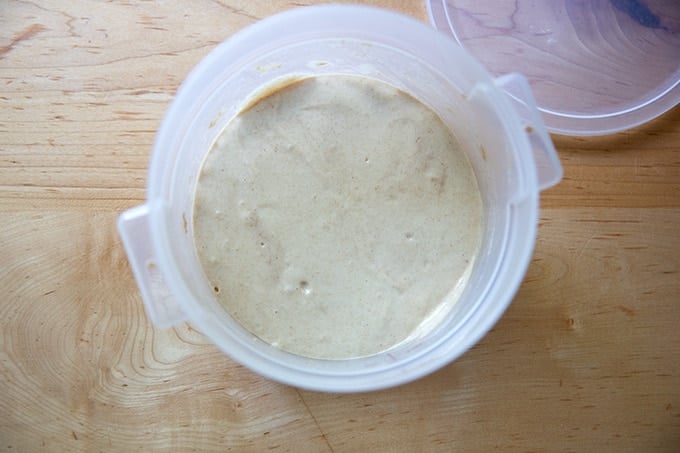
… give it a stir.
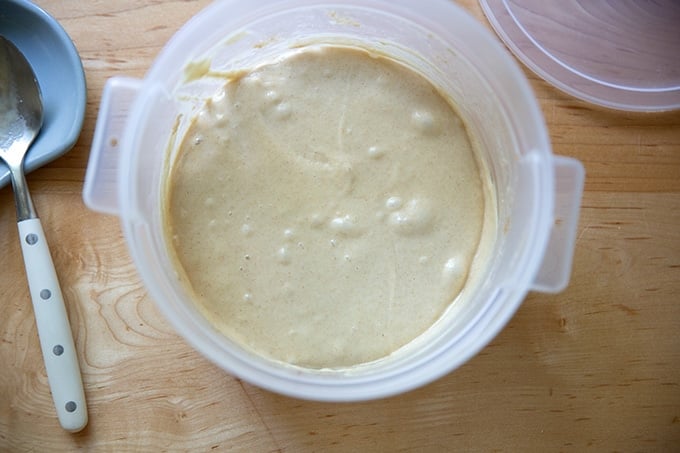
Re-cover the vessel, and record your work. Let it sit at room temperature for another 24 hours.
Day 3: Uncover the vessel.
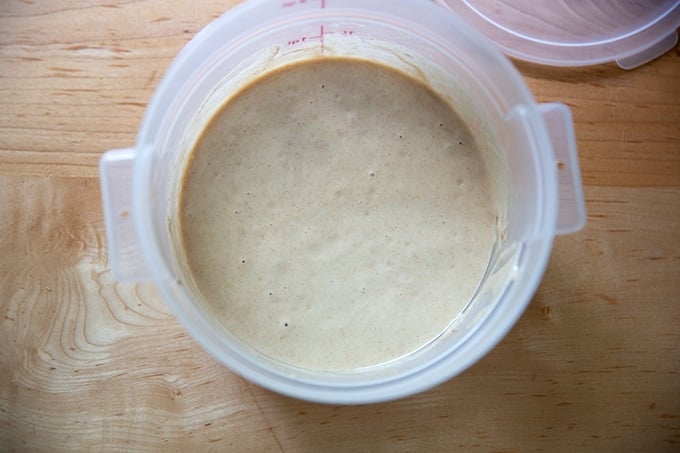
Measure out 128 grams (about 1 cup) of flour and 128 grams (about 1/2 cup) of water:
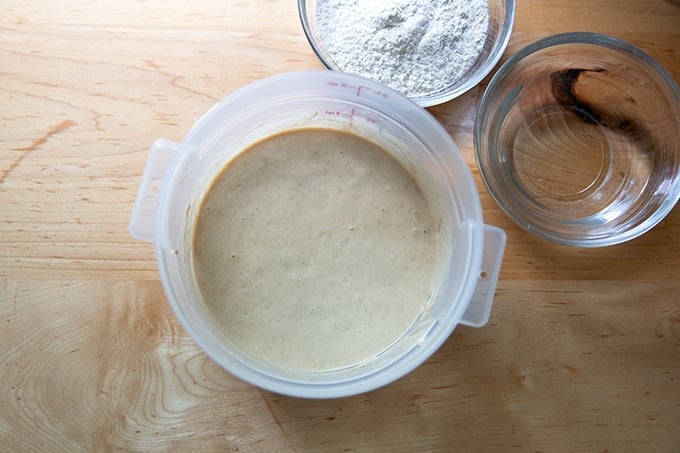
Add them to the vessel.
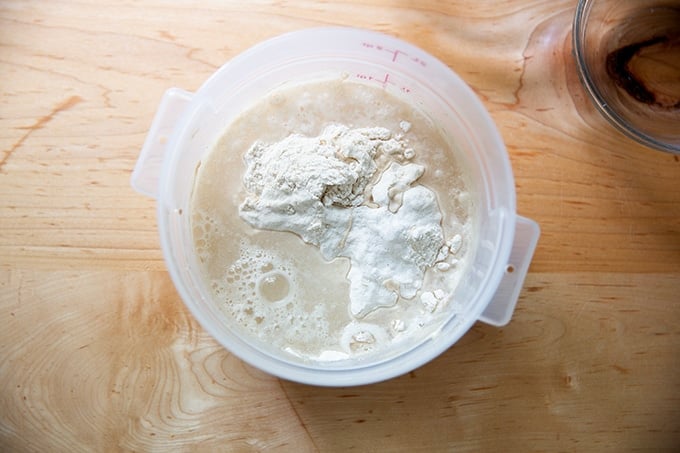
Stir to combine.
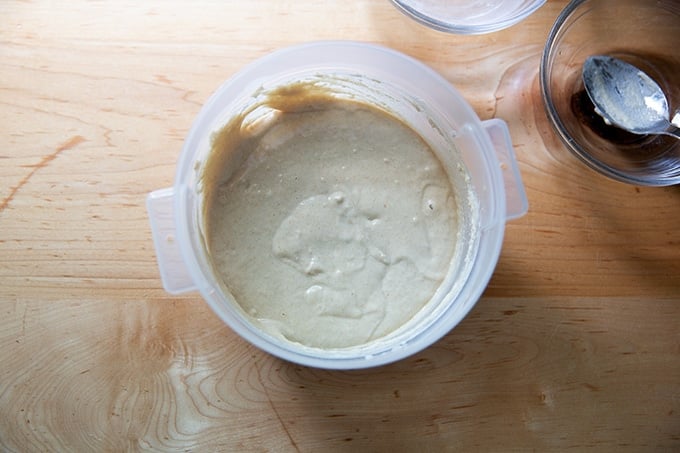
Cover the vessel and record your work again. Let it sit at room temperature for 24 hours, stirring once or twice.
Day 4: Uncover the vessel. You should see a little action (bubbles). Measure out 128 grams (about 1 cup) of flour and 128 grams (about 1/2 cup) of water:
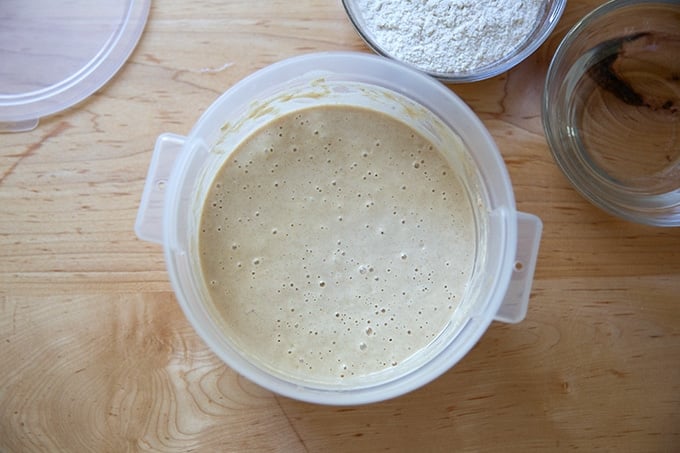
Add them to the container.
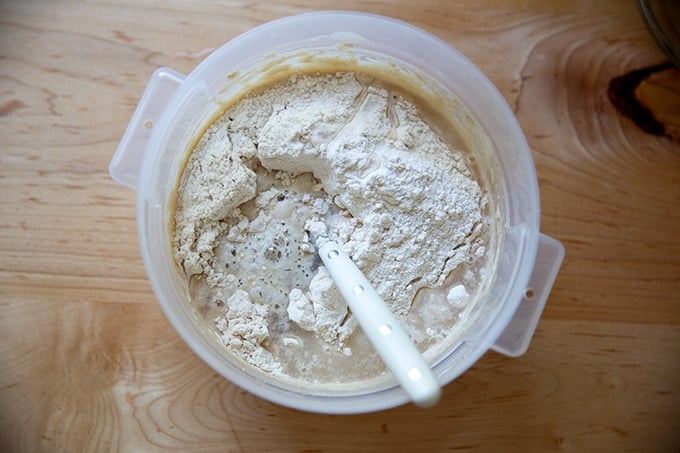
Stir to combine.
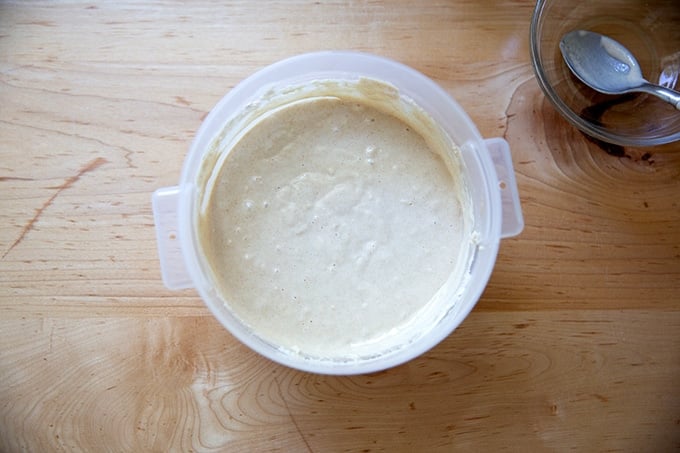
On this day, record your work again, and mark the height of your mixture with tape on the side of your vessel. Let it sit at room temperature for 24 hours, keeping a closer watch this time around.
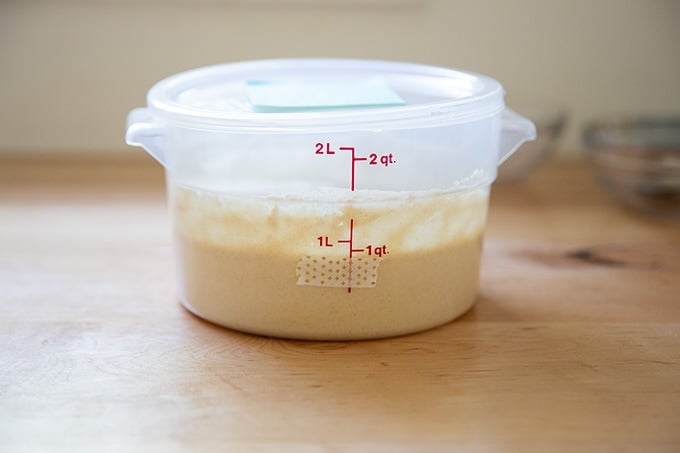
You will likely see some action…
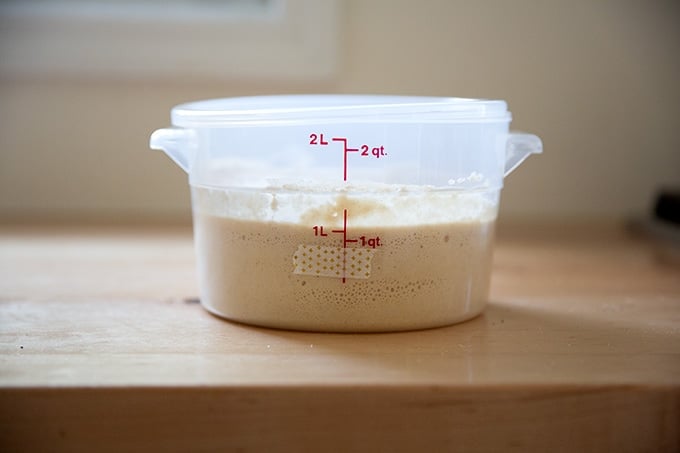
The mixture might even double in volume.
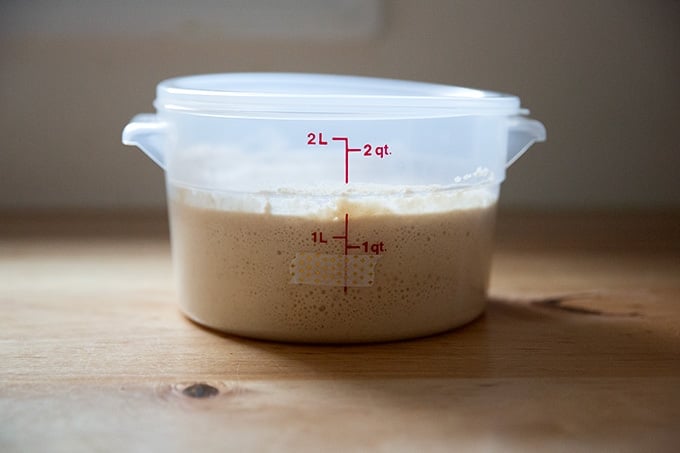
And you should see lots of bubbles on the surface.
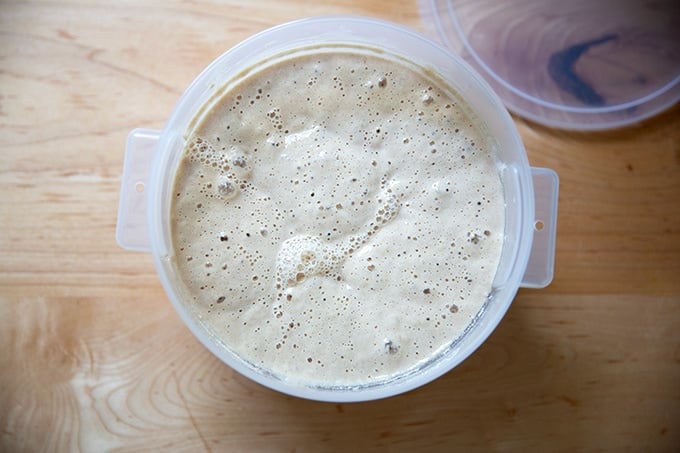
If your mixture is in fact rising, let it rise until it nearly doubles in volume; then drop a spoonful of it in water. If it floats, you’re in business. Note: Your starter might rise (and maybe fall) while you are sleeping — don’t worry if you don’t “catch” it at its peak. Continue on with the process that follows.
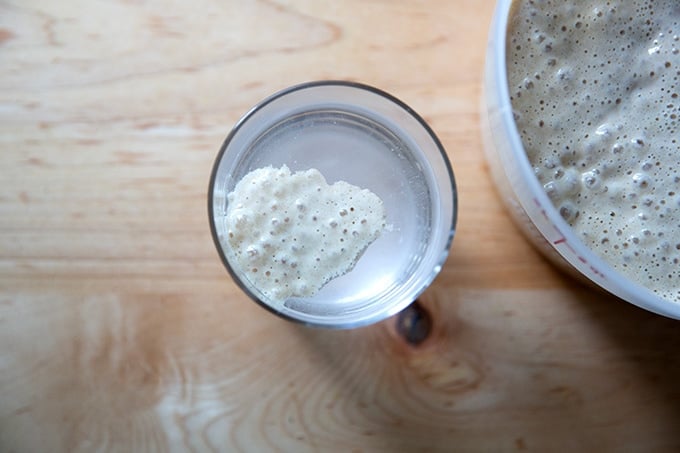
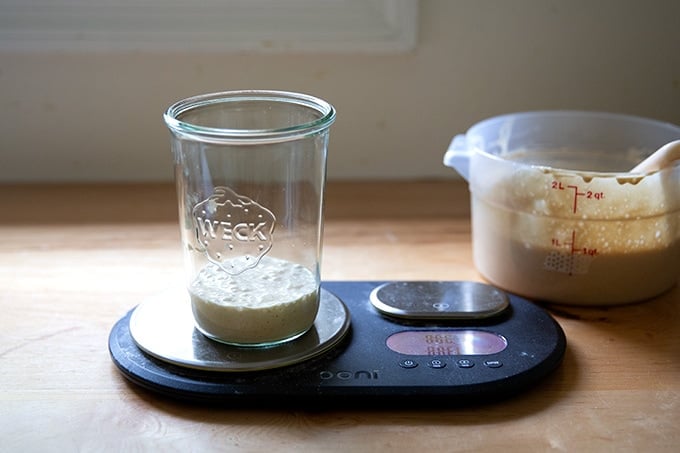
Spoon 128 grams of the starter into a new vessel.
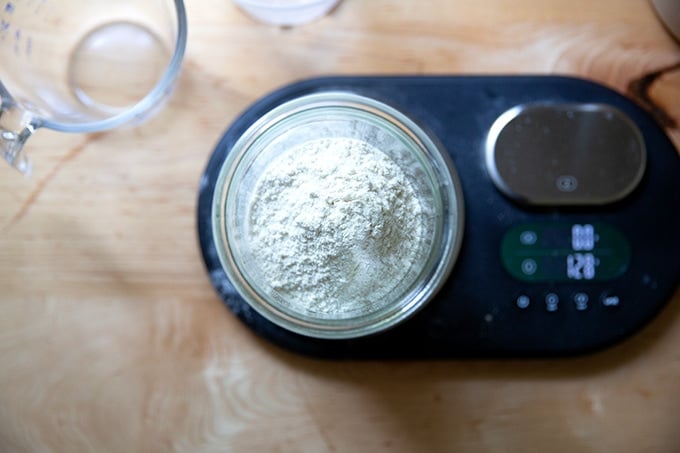
Measure another 128 grams of flour and water each.
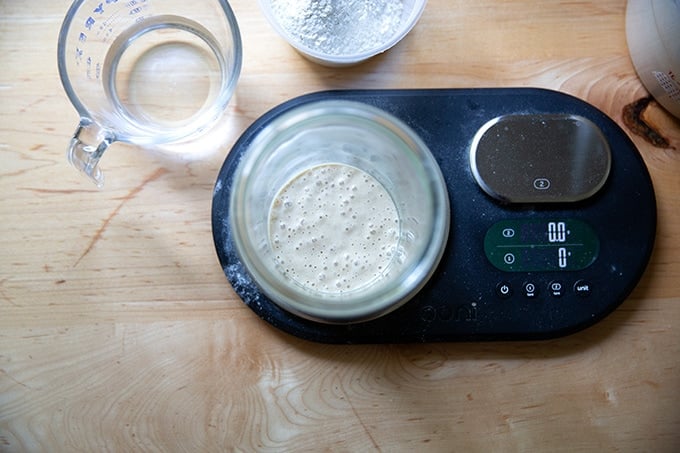
Add the flour and water to the starter.
Stir to combine.
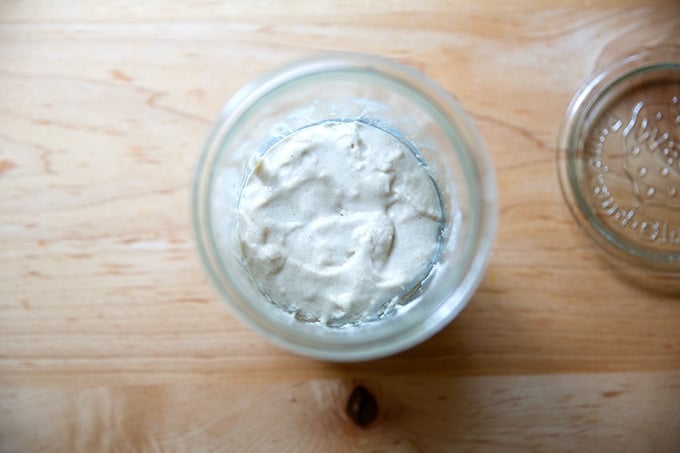
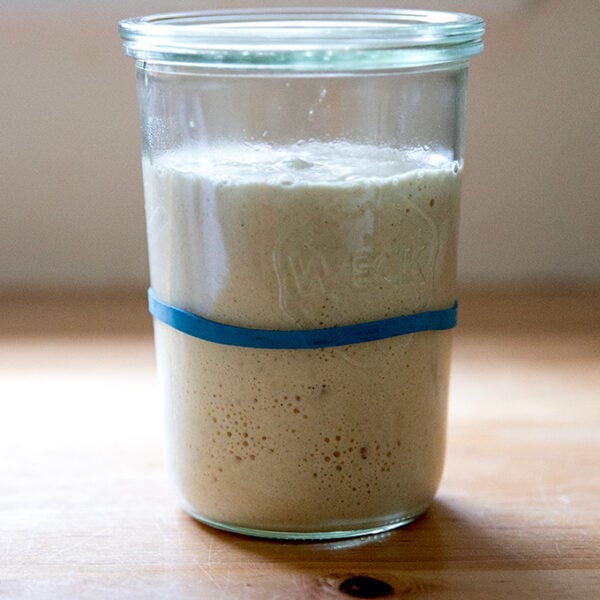
Mark the height with a rubber band.
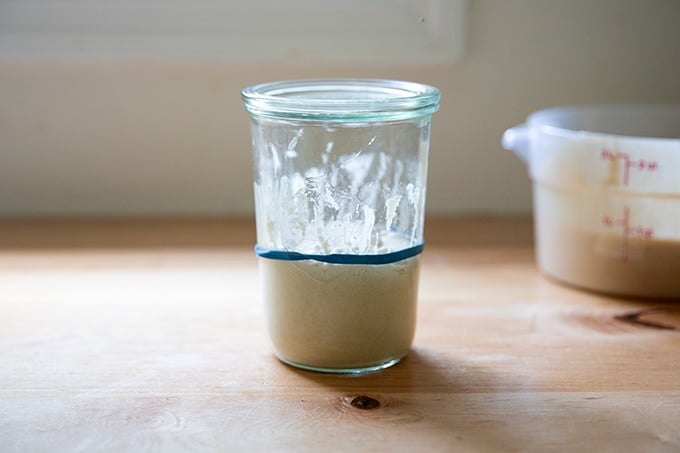
This original vat of sourdough starter is now your discard bucket. Transfer it to the fridge or use it in one of your favorite sourdough discard recipes: tortillas, crackers, pancakes, soda bread.
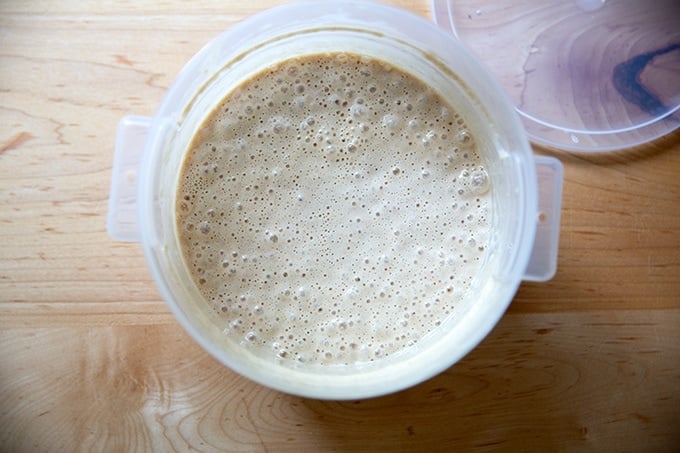
Day 5: When your starter doubles…
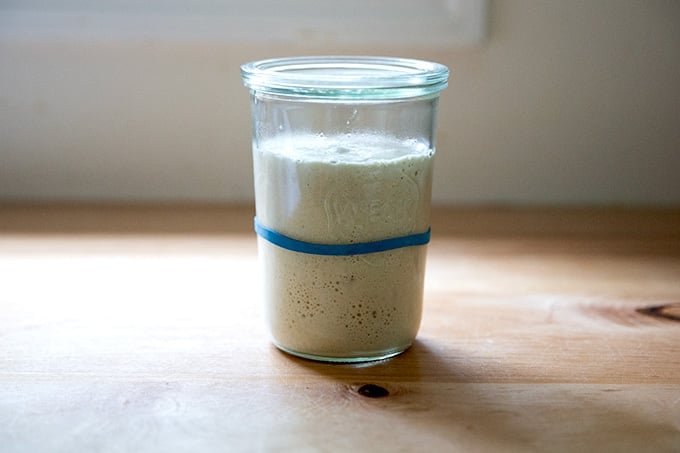
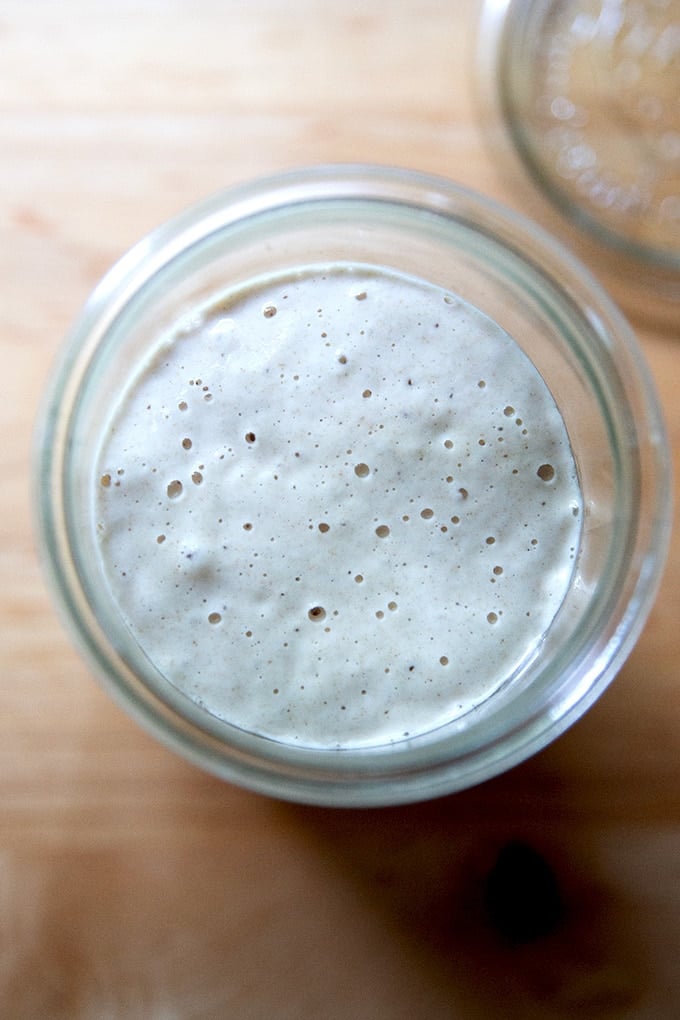
… and floats…
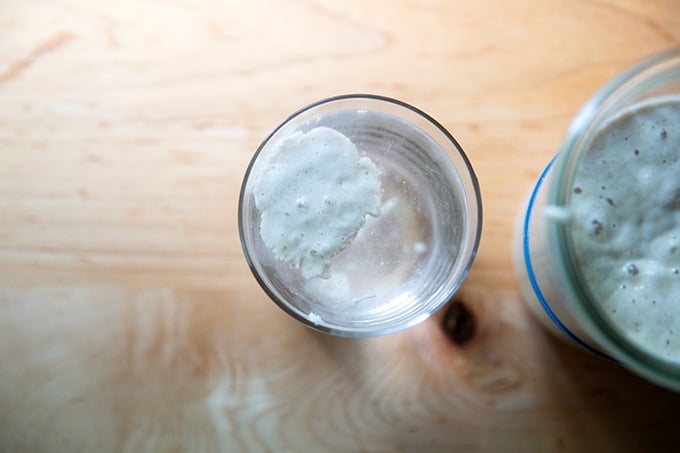
…you can do one of three things:
- Repeat this process: spoon 128 grams of starter into a new vessel and add 128 grams each flour and water. (Transfer the remaining starter to your bucket of discard.) Let the new starter rise until it doubles. Your starter will get stronger with every feeding.
- Transfer it to the fridge if you need to take a break from the process. You can pick up where you let off when you are ready.
- Test it out…
… in a sourdough bread recipe. I recommend starting with…
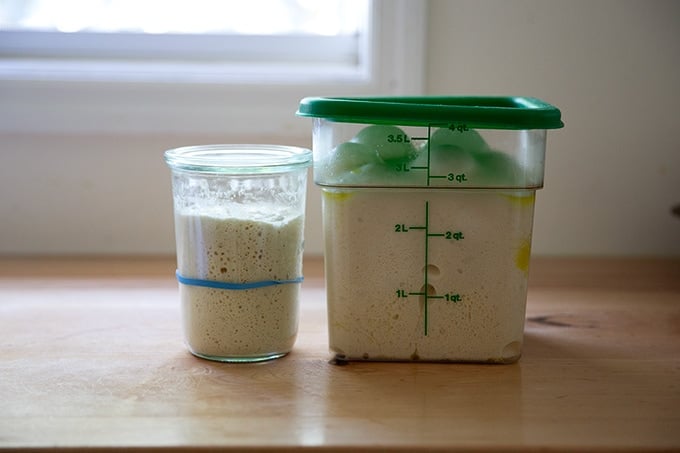
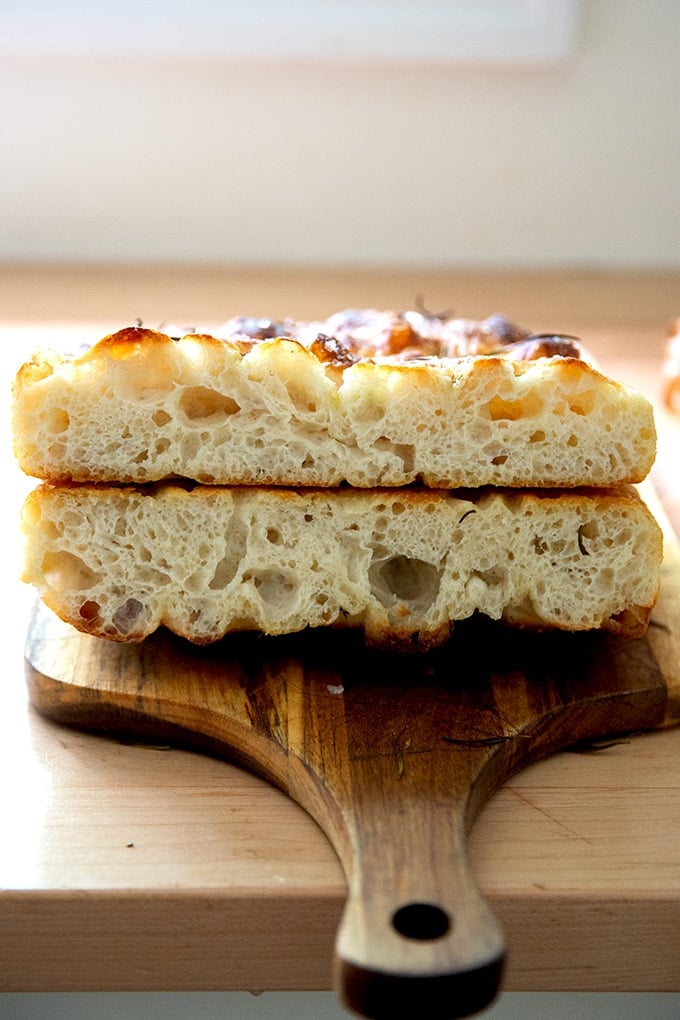
… focaccia, one of the easiest breads to make.

How to Build a Sourdough Starter from Scratch
- Total Time: 5 days
- Yield: 3 cups 1x
Description
This post outlines how to build a sourdough starter from scratch simply and quickly. In less than a week, with minimal effort, you will have a bubbly, active starter on your hands to use in all your favorite sourdough recipes.
Notes:
Adapted from Peter Reinhart’s method, outlined in Perfect Pan Pizza (and many of his other books as well).
If you are looking for guidance on how to feed, maintain, and store your already strong starter, see this post: How to Feed, Maintain, and Store a Sourdough Starter.
5 Tips for Success
- Use a scale to measure. It is the only way to measure accurately.
- Use a straight-sided vessel, which will help you more accurately see how much your starter is growing.
- Attempt this project while it’s hot outside or create a cozy place for your starter to rise: Ideally, the cozy place you create will be between 70ºF (21ºC) and 80ºF (26ºC).
- Find a warm place in your kitchen (like on top of your refrigerator) to let it rest.
- Invest in the Brod and Taylor Sourdough Home: I do not own this, but it gets good reviews, should you have the space for it.
- Use your Instant Pot! One of you suggested the following: Press the Yogurt button once; use the “Temp/Pressure” button to set the temperature to Low. Change the time to however many hours you need.
- Use a Heating Pad: One of you ingeniously made a homemade proofing box by placing a seed heating pad in a box and covering it with a towel.
- Try the warm oven trick: turn your oven on for 1 minute (at any temperature) and then turn it off. Consider sticking a post-it note to the oven to remind you that you have a starter in there so that you don’t accidentally preheat your oven and kill your starter.
- Another idea: Turn the oven light on for 10 to 15 minutes, then shut it off. I caution against keeping the oven light on the entire time because it potentially will create a too-warm space (especially in a newer oven) that might kill your starter. A great tool to invest in is an ambient temperature thermometer, as it will help you accurately gauge the temperature of the cozy spaces you create to help your starter thrive
- Use freshly milled stone-milled flour. If you have a source local to you, use it! Health food markets, co-ops, or markets such as Whole Foods often carry freshly milled flour. Here are a few mail-order options:
- Water: If your water is RO or if you have concerns about your water, you can:
-
- Use water that you’ve left out overnight to ensure any chlorine has evaporated.
- Buy spring water. In some places, letting water sit out overnight will not be effective, and your tap water may kill your starter.
Discard: At the end of the first four days of the process, you’ll be left with a decent amount of sourdough discard, which you can use in countless recipes. Here is my collection of Sourdough Discard Recipes.
Ingredients
- 192 grams (about 1 1/2 cups) stone-milled flour, see notes above
- 192 grams (about 3/4 cups) water or pineapple juice, see notes above
Instructions
- Day 1: Ideally, you are using a straight-sided vessel for this project; otherwise, a large bowl is fine. (Note: A straight-sided vessel allows you to truly see how much your starter is growing. I’m using this Cambro.) Stir together the flour and water (or juice) until the flour is absorbed. Cover the vessel. Record the date, time, and measurements — you will forget which day you started if you don’t. Let it sit in a cozy environment — 75ºF to 80ºF is ideal (see ideas above) — for 24 hours. If you remember, stir the starter once or twice over these 24 hours.
- Day 2: Uncover the vessel. Stir the mixture. Re-cover the vessel, and record your work. Let it sit in a cozy environment for another 24 hours. If you remember, stir the starter once or twice over these 24 hours.
- Day 3: Uncover the vessel. Add 128 grams (1 cup) of flour and 128 grams (about 1/2 cup) of water. Stir to combine. Cover the vessel, mark the height of your mixture with tape, and record your work again. Place it in a cozy spot. If possible, monitor your starter over the next 8 to 10 hours and if…
- …your starter doubles or begins to double, feed it with 128 grams each flour and water. If it doubles again before it’s time for you to go to bed, skip to Day 5 and proceed with making the offshoot. If it doesn’t, let it in a cozy environment overnight. Then proceed with making the offshoot (step 5) in the morning.
- … you are not seeing much action, continue to let it sit in a cozy environment till the following day, stirring it once or twice. Proceed with Day 4 in the morning.
- Day 4: Uncover the vessel. You should see some action (bubbles), and your starter should smell pleasant, not unlike a fruity yogurt. Stir it, then feed it with 128 grams each flour and water. Stir to combine. Cover the vessel, mark the height of your mixture with tape, and record your work again. Place it in a cozy spot. If possible, monitor your starter over the next 8 to 10 hours and if…
- …your starter doubles or begins to double, drop a spoonful of it in water. If it floats, you’re in business. Skip to Day 5 and proceed with making the offshoot.
- … your starter is not quite doubling, continue to let it sit in a cozy environment till the following day, stirring it once or twice. Proceed with Day 5 in the morning.
- Day 5: At this point, you should be observing some activity in your starter, meaning the starter should have risen slightly (perhaps doubled but perhaps not) and fallen with bubbles transforming from big to small. You’ll now take a small portion of this mixture and build a new starter: Transfer 100 grams of the starter to a new jar or vessel, and add 100 grams of flour and 100 grams of water. Stir well to combine, then cover the jar. Mark the height with a rubber band. Let it sit in a cozy spot. Transfer the remaining starter to the fridge — this original mixture is now your sourdough discard and can be used in all sorts of recipes, see notes above. When your new starter doubles in volume, you can do one of three things:
- Repeat this process: spoon 100 grams of starter into a new vessel and add 100 grams each of flour and water. (Transfer the remaining starter to your bucket of discard.) Let the new starter rise in a cozy spot until it doubles. Your starter will get stronger with every feeding.
- Transfer it to the fridge if you need to take a break from the process. You can pick up where you left off when you are ready.
- Test it out in a sourdough bread recipe.
- Maintaining your starter: Once you have a strong, active starter on your hands, follow the steps in this post: How to Feed, Store, and Maintain a Sourdough Starter.
- Category: Bread
- Method: Stir
- Cuisine: American
This post may contain affiliate links. Please read my disclosure policy.













582 Comments on “How to Build a Sourdough Starter from Scratch”
Good afternoon Ali,
If I want to start over using fresh milled flour ( I’m just starting to get the toes wet with fmf) would I use hard red or white wheat berries. I also have some Linden Farms super sprouted flour , would that work for a starter?
Sorry for all the questions.
Your cookbooks and website have been such a fabulous resource for me.
Thank you, Beth… so nice to hear 🙂
When I say freshly milled flour — and I should clarify this for everyone — I mean freshly milled/stone milled from a local source. I am not milling wheat berries myself. I don’t have a mill, and I’m not sure how to advise regarding the wheat berries as I’ve never done this.
I think your Linden Farms super sprouted flour would work beautifully!
Thank you for the quick response.
My sourdough starter was going gangbusters on day 3, when I fed it twice. But then overnight it seems to have died. I split off some and fed it today, but the offspring also appears lifeless. What could I have done wrong?
Hi Sue! It is OK/normal that your starter had been doing “well” and somehow now appears to not be doing so well… some people call it a starter “fake out”. It is common for a starter to go gangbusters in the beginning due to the rush of activity as the wild yeasts and bacteria feed like crazy on all of the “food” (the flour/water). As your starter matures/ripens, it becomes more acidic, and some of these microbes can’t survive… as they die off, the starter looks inactive, but it just needs time: more consistent feedings with fresh food and water and a warm place to rise.
Just keep at it with the feedings… it becomes a tedious process and, again, may take as long as 2 weeks to double consistently.
My starter looked quite active at first, and looks bubble after I feed it, but by the time it is time to feed it again there is no activity and the liquid has separated and floats on top. No doubling action. I’m storing it in a warm oven and using stone ground flour. Where have I gone wrong?
Hi! When you say warm oven, can you elaborate? Do you know the exact temperature?
I don’t know precisely (I ordered that thermometer but it won’t arrive until like…June), but I preheat it for about thirty seconds and then turn it off, and do this one or two other times through the day. This is the same method I use for rising the peasant bread, which I make multiple times a week, and seems to work well?
I’m also seeing that there’s some mold forming inside the container, so I must have done something incorrectly. I’ll start over.
Oh shoot, mold unfortunately means you’ll need to start over. Is it definitely mold? As opposed to the flour looking discolored? In my first video of the email course, I worried people were going to think that my starter was moldy, but it was just the flour discoloring due to air exposure.
That should be fine! I just worry about a too warm environment potentially causing issues but with your method, that should not be causing a too warm environment.
Know that it is OK that your starter had been doing “well” and somehow now appears to not be doing so well… some people call it a starter “fake out”. It is common for a starter to go gangbusters in the beginning due to the rush of activity as the wild yeasts and bacteria feed like crazy on all of the “food” (the flour/water). As your starter matures/ripens, it becomes more acidic, and some of these microbes can’t survive… as they die off, the starter looks inactive, but it just needs time: more consistent feedings with fresh food and water and a warm place to rise.
Hi Ali! On Day 5 when you have your “new new starter” or the second off shoot starter, how long do you continue to feed it 100 grams of flour/water for before being able to drop down to 45? Or is the discarding all but 100 and then adding 100 grams flour/water only performed until you see doubling? I am someone who plans to bake sourdough weekly so I am wanting to keep my starter in the fridge. Basically, looking for when the starter is good to go into the fridge and you can drop feedings down to 45 grams each. Hopefully this makes sense and thank you in advance!
Hi! So the first offshoot is a 1:1:1 ratio: 100 grams each starter, flour, water. After this, I switch to a 1:2:2 ratio: 50 grams starter, 100 grams flour, 100 grams. Keep in mind, I am eyeballing the 50 grams — I discard most of my starter into my discard bucket leaving roughly 50 grams (about 1/4 cup) behind; then I feed this with roughly 100 grams each flour and water. It doesn’t have to be so, so precise.
Ideally, you’d feed your starter as soon as it doubles, again by discarding most of it and feeding it with fresh flour and water. If you do this 2 to 3 times a day depending on how your starter is behaving, you will build up its strength quickly. When your starter gets to a point when it is doubling within 6 to 8 hours, you can start storing it in the fridge — store it at its peak.
When you are ready to bake, you’ll remove the starter from the fridge, discard most of it (or save it in your discard bucket), then feed it with fresh flour and water. You may want to do this twice before baking.
Once your starter is vigorous, you can keep a smaller starter on hand. If you want to feed it with 45 grams each flour and water, I’d place 20-25 grams of starter in a jar, feed it with 45 grams each flour and water, let it double, then store it in the fridge.
Let me know if that clarifies.
Well, I’m on day five and I think my starter was killed because the Temperature fluctuation. I would put it in the oven with the oven light on and then get the temperature between 70 and 77° and then turn it off and it would drop down to 61 degrees. My starter does not have any bubbles and it’s very liquid.. my question is, how can I maintain a temperature in a climate that is cooler? I live in Chicago. It’s not warm here right now.. I don’t want to purchase a sourdough keeper for this purpose and spend the money, are there any other tricks to maintain a temperature?
Hi! Once you have a thriving starter, you don’t have to worry so much about your cold climate — I store my starter in the fridge for months at a time, and when I am ready to bake with it, I pull it out, and then use my tricks to create warm spaces for it so that it revives in a timely manner. In this building phase, you will have more success if you do keep at it with creating that warm space in your oven. Have you created your offshoot? What kind of flour are you using? And are you at all concerned about your water source? It’s not RO, is it?
Hello, I was not able to make an offshoot because I felt like my starter diminished and there were no longer any bubbles. It was just flat. I used King Arthur organic bread, flour, and just regular tapwater. I don’t have RO. I Found it very difficult to maintain a cozy area in my house. My room temperature is around 63°. The starter lived in my oven and I would turn on the light, leave it on for a while. It reached 77 to 83° and then I would turn it off for the duration of the night and in the morning it was only 61° in there.. unless, if you feel it was something else I did. I am going to start over. I really feel determined to make my own starter.
Hi! It is totally normal for your starter to look diminished/sluggish — did you toss it? If you didn’t, I think it is worthwhile taking 128 grams of it and feeding it with fresh flour and water, and then proceeding with the feedings as directed moving forward. The sluggishness is just a sign that it needs to be fed. It is definitely hard creating that cozy place, and you may have better luck in the summer, but I do think the work you’ve done so far has potential!
Hi Ali,
It’s there a chance you could resend Day 5 to me. I can’t find it anywhere in my emails.
Thank you
Beth
Jelkschef@aol.com
Just sent it! Let me know if you still haven’t received it.
No mam. And is there a day 6 because i didn’t get it either.
Thank you.
Yes, there is a day 6. Check your spam folder for both. In the meantime, I will try forwarding them from my email or re-sending.
By the end of day 4 on the Sourdough starter challenge I am not seeing any rise. I do see some bubbles and the texture has improved as you mention. I am using 50% Organic Regeneratively grown Whole Grain Stone-milled Heritage Rye Flour and 50% Bob’s Red Mill Unbleached Enriched Artisan Bread Flour. I have had great success using this for your other sourdough recipes. Day 1 – initial 192 gram feed, Day 2 – stir, Day 3 – 128 gram feed, Day 4 – 128 gram feed. I have not seen a typical rise (or fall) at this point. My plan is to continue with Day 5 instructions tomorrow morning assuming that it is just slow to ferment. I have it in a small, windowless enclosed room with a heater keeping the temp around 75 degrees at the bowl. Any advice / comments are appreciated.
It sounds as though you are doing everything right — good flour, cozy spot, etc. Are you concerned at all about your water source? Is your water RO water? Bubbles + better texture is are good signs. And at this point it is important to make that offshoot. My only other thought would be to try creating an even cozier spot using your oven: Leave the light on for 15 minutes, then shut it off. Or preheat it for 1 minute, then shut it off.
My starter is doing great! Just over double again since last night. 🙂
Question re: discard– I will make some pancakes and probably sandwich bread, but I don’t have time to bake that often. I now have lots of discard, and will have more right after I feed it, so not sure I can use it all for a while yet. How long can my discard last in the fridge?
Thank you!
…also, I know you’ve mentioned that starters can have varied consistency. My discard is quite thick. Is that because it’s been in the fridge? Is there such a thing as “too thick” when it comes to discard? (I can stir it, but it’s much thicker than yours looks.)
🙂
Nope! That’s totally fine. You might find that it thins out as it sits. Also, a small layer of liquid sitting on top (the hooch) is fine to stir back into the discard. I just checked on my bucket, which is nearly 3 weeks old at this point, and I stirred the hooch back into the mixture, it smells fine, and has the texture of almost crepe batter — it’s in great shape.
Thanks to both of your replies! ☺️🙏
Hooray! Great to hear this. The discard can keep in the fridge for 2-3 weeks (maybe even longer). I’d mark the date so you have a reference.
Hello! This has been so much fun! I’m at day 5 and my starter is beautiful – bubbly, light, stretchy and it floats.
However, from the the beginning it doesn’t smell good to me. It smells sour and fermented (which I know is the point of what we are doing). My other starters have smelled good and yeasty in the past. Not this one. Is this normal? This is my first time using FMF.
Great to hear re bubbly, light, floating… hooray!
The strong, alcholic or vinegary smell is normal, and that will go away as it gets stronger. Smell it right after you feed it (discarding most of it first); smell it again when it has risen 50% and smell it again at 100%. It should smell pretty mild at those phases, and then when it gets past peak, it will start smelling worse. But again, the stronger it gets, the better it will smell.
Are you milling the flour yourself or buying it from a mill/store?
Another question for you, Ali: Can I use just 25g for my twice daily feeding rather than 50g? Is there a reason to stick with 50g each time? Thanks!
You can try! At these early phases, it might be beneficial to have a larger starter amount, the idea being you have a larger pool of yeast and bacteria that you feed and in turn help multiply/colonize. But if you notice good rising with the 25 gram starting amount — go for it. I love the idea of being able to use less starter and being able to then have to feed it less flour.
My starter is the BEST! In just a week it was healthy and strong, and I made it myself! I’m so proud!! Thank you, Ali, for your lessons and tips! I used it on Day 6-7 to make a ramp and cheddar focaccia for my cookbook club. Raves all around and they devoured every bit! It truly was the best focaccia I’ve ever made. I used your recipe with the modifications from a focaccia I purchased at the Troy (NY) farmers market a couple of years ago made by Matt from Forts Ferry Farm who kindly shared his tips. I used olive oil in which I had confited the ramp bulbs, the ramp greens blended with ice to keep them green, and cheddar grated on top. I wish I could share a photo here! — Stephanie xo
Amazing to read all of this, Stephanie! Thanks so much for writing and sharing this — so encouraging from others. Also: Matt from Forts Ferry Farm is the best. His pizza lunches at the farm were SO good. Some of the best pizza I’ve ever had. Wish they would bring those back. Your cheddar-ramp focaccia sounds insane. If you feel like emailing me a photo, I’d love to see it: alexandra@alexandracooks.com
Hi Ali,
My starter was going great until yesterday. I just went back and read a similar question and your answer, so I’ll keep plugging away. Thought I’d ask this though…
My discard has been in the fridge for a few day. It is still quite lively and very bubbly. Is that because I’m adding more and more discard?
I did my offshoot the day before yesterday, fed it and it was well doubled by yesterday morning. I fed it again, but it only rose a bit. I fed it very early this morning. Now, we’ve been out all day, just got home and our kitchen is cool—but it’s hardly risen a smidge. I will feed it now and have it sitting in our microwave with the light overhead to warm the area, which usually does the trick. If you have any further suggestions other than keep feeding it, I’d love to hear them. Thank you in either case! 🙂
It sounds as though your offshoot is just responding to the various temperature swings, which is totally fine. I would just keep plugging away with the feedings — it is definitely tedious at this point. Be sure to discard most of it (leaving 50 grams or so behind), feed it with fresh flour and water, stir well, and find that cozy place for it to rest.
Regarding the discard which still looks active, yes, I think it is because you are continuing to feed it with good amounts of discard. But at this point, it is probably too acidic to make a good loaf of bread. And while it appears lively, I think you’ll find that it will deflate quickly upon being stirred and may not recover after being stirred/deflated. I hope that answers your question 🙂
It does, thank you! I do plan on making at least a couple of your discard recipes!
I’ll keep plugging away and continue to feed. 🙂
Hi Ali,
Another question? In the last email, you wrote about using somee of the starter in regular bread recipes. Would this work for the wonderful peasant bread recipe? That recipe is such a mainstay around here.
Thank again for a great challenge
Beth
Yes! You can use 50-100 grams of starter in that recipe. Omit the yeast. If the dough is too wet, you may need to sprinkle in some more flour but keep in mind the peasant bread dough is very wet. Add one set of stretches and folds. And finally just be patient with the rises — each rise will take much longer due to the nature of sourdough.
Thanks.
Hi Ali, so I did the week with the starter and at this point I’m discarding and feeding twice daily. I get good growth, maybe not doubled, but nice and fluffy. question – last night I saw it had almost doubled already, but this morning had fallen. I think this is happening a lot. any insight? thanks!
Hi Kim!! I’m so happy to hear you participated. Great to hear about your starter — it sounds like it is very healthy/active. And yes, it is totally normal for your starter to double, then fall — when it falls, it just means it is ready to be fed again. When you are really trying to strengthen it, if you feed it when it’s at its peak, you’ll see your starter rise more quickly. But there is no harm in letting it rise and fall — mine does this ALL the time. It’s hard to always catch it at its peak.
I’m excited to start this!
Is bread flour ok? Or only AP flour needed?
Thanks!
Either is fine! But ideally you’re using a stone-milled flour — do you have a co-op or health food store or even a Whole Foods near you?
We are going away for the weekend. Can I just leave my starter in the proofer and refresh it when we return?
I would move it to the fridge. What is the proofer set at?
78 degrees
OK, yeah, I would move it to the fridge. You can pick up where you left off when you return.
Hi – I am on day 4 and the starter was looking quite thin and watery but no funny smell and no sign of mold.
In one of the comments someone said they did the hero test – what is that?
At what stage should I be concerned if there is still no doubling?
Hi! I’m not familiar with the “hero” test… the only test I know is the float test.
Honestly, it may take as long as 2 weeks to double consistently.
What kind of flour are you using? And are you creating a cozy space for it to rise? Do you have any concerns about your water? Is it RO?
I have been following your daily suggestions for making my own sourdough starter, and I’m on my second try using a different flour brand called ‘Manny’s Choice’ – I coudn’t find any locally milled flour nor did I want to wait to order it. So I am on day 7 0r 8, I have been feeding it 2x a day with the 1:2:2 ratio, and though it looks good and bubbly, it really is not raising or even beginning to double. I am concerned about keeping it warm enough during the day, though our indoor temperature is usually about 74 or warmer, so that should be good at room temperature. I try to boost the temperature sometimes, in the oven with the light on for a while, or near the pilot light of the fire place. Do I just keep feeding it 2x a day, and what if it never rises but appears healthy. Just do the float test?
Hi Bonnie! 74ºF or warmer should be a nice environment, though I do find that closer to 80ºF really does boost the progress along, so I’d continue to create those warm spaces for it. Are you at all concerned about your water source? Is it RO water? And is the Manny’s Choice flour type 0? I just googled it to learn more, and that’s what I’m seeing.
Hej Ali! Great directions and while I was worried a few days ago that my starter seemed watery the offshoot is a rockstar and is ready to store in the fridge. Once at this point how often should I be feeding the offshoot moving forward?
Hooray! Great to hear this, Crystal. Moving forward, you honestly can leave your starter in your fridge for months without feeding it. This isn’t optimal, but know that even if neglected for several months, you will be able to revive it with a few feedings: if you notice any grey liquid floating on the top, discard that, then proceed as usual: discard most of it (down to 50 grams or so), then feed it with 100 grams each flour and water. Repeat the feeding once the starter doubles or use it in a recipe. I find that when I don’t feed my starter for months, I like to feed it at least twice before using it.
A better plan, however, especially since your starter is still relatively young, would be to feed it once every 2 weeks or so. This will keep it a little healthier and again, because it is young, it will help it continue to build its strength.
Hello! I have a nice starter that I made a few weeks ago from your great tutorial. Yesterday I forgot to remove the discard from my starter before I fed it. Is that ok? After a day it looks bubbly. Just wondering how to proceed. Thanks!
That’s fine! Bubbles are a good sign. Just remember: starters are very forgiving and very easy to “fix”. Moving forward, I would stick to discarding most of it (down to a few tablespoons), then feeding with equal parts by weight flour and water (75-100 grams of each).
My starter doubled from day 1 to day 2 at 75-76 degrees! Have I done anything wrong? Should I continue with the steps as published?
Thanks.
Hi!! So sorry for the delay here. Doubling in 1-2 days is a great sign! Your environment is perfect for building a starter. A cozy environment always helps. Yes, proceed with the recipe. Out of curiosity, what kind of flour (brand included) are you using?
Hi Ali. All downhill since my original email. Initial rise deflated end of day 2 and starter has not developed bubbles or risen since then despite following the daily schedule. It is very thin and develops brown liquid each day.
I started an offshoot today and was initially encouraged by a few bubbles but it is flat with more brown liquid on top.
I started with Kroger bleached AP flour but last several days have been using Target unbleached AP flour.
Is it not being fed enough? Should I start over?
Hi Alexandra, i have wholemeal plain flour and an unbleached plain bakers flour. Could you please tell me which is best to use?
Hi Deana! Apologies for the delay here. I would start with the wholemeal plain flour, then switch to the bakers flour around day 5.