Description
This post outlines how to build a sourdough starter from scratch simply and quickly. In less than a week, with minimal effort, you will have a bubbly, active starter on your hands to use in all your favorite sourdough recipes.
Notes:
Adapted from Peter Reinhart’s method, outlined in Perfect Pan Pizza (and many of his other books as well).
If you are looking for guidance on how to feed, maintain, and store your already strong starter, see this post: How to Feed, Maintain, and Store a Sourdough Starter.
5 Tips for Success
- Use a scale to measure. It is the only way to measure accurately.
- Use a straight-sided vessel, which will help you more accurately see how much your starter is growing.
- Attempt this project while it’s hot outside or create a cozy place for your starter to rise: Ideally, the cozy place you create will be between 70ºF (21ºC) and 80ºF (26ºC).
- Find a warm place in your kitchen (like on top of your refrigerator) to let it rest.
- Invest in the Brod and Taylor Sourdough Home: I do not own this, but it gets good reviews, should you have the space for it.
- Use your Instant Pot! One of you suggested the following: Press the Yogurt button once; use the “Temp/Pressure” button to set the temperature to Low. Change the time to however many hours you need.
- Use a Heating Pad: One of you ingeniously made a homemade proofing box by placing a seed heating pad in a box and covering it with a towel.
- Try the warm oven trick: turn your oven on for 1 minute (at any temperature) and then turn it off. Consider sticking a post-it note to the oven to remind you that you have a starter in there so that you don’t accidentally preheat your oven and kill your starter.
- Another idea: Turn the oven light on for 10 to 15 minutes, then shut it off. I caution against keeping the oven light on the entire time because it potentially will create a too-warm space (especially in a newer oven) that might kill your starter. A great tool to invest in is an ambient temperature thermometer, as it will help you accurately gauge the temperature of the cozy spaces you create to help your starter thrive
- Use freshly milled stone-milled flour. If you have a source local to you, use it! Health food markets, co-ops, or markets such as Whole Foods often carry freshly milled flour. Here are a few mail-order options:
- Water: If your water is RO or if you have concerns about your water, you can:
-
- Use water that you’ve left out overnight to ensure any chlorine has evaporated.
- Buy spring water. In some places, letting water sit out overnight will not be effective, and your tap water may kill your starter.
Discard: At the end of the first four days of the process, you’ll be left with a decent amount of sourdough discard, which you can use in countless recipes. Here is my collection of Sourdough Discard Recipes.
Ingredients
- 192 grams (about 1 1/2 cups) stone-milled flour, see notes above
- 192 grams (about 3/4 cups) water or pineapple juice, see notes above
Instructions
- Day 1: Ideally, you are using a straight-sided vessel for this project; otherwise, a large bowl is fine. (Note: A straight-sided vessel allows you to truly see how much your starter is growing. I’m using this Cambro.) Stir together the flour and water (or juice) until the flour is absorbed. Cover the vessel. Record the date, time, and measurements — you will forget which day you started if you don’t. Let it sit in a cozy environment — 75ºF to 80ºF is ideal (see ideas above) — for 24 hours. If you remember, stir the starter once or twice over these 24 hours.
- Day 2: Uncover the vessel. Stir the mixture. Re-cover the vessel, and record your work. Let it sit in a cozy environment for another 24 hours. If you remember, stir the starter once or twice over these 24 hours.
- Day 3: Uncover the vessel. Add 128 grams (1 cup) of flour and 128 grams (about 1/2 cup) of water. Stir to combine. Cover the vessel, mark the height of your mixture with tape, and record your work again. Place it in a cozy spot. If possible, monitor your starter over the next 8 to 10 hours and if…
- …your starter doubles or begins to double, feed it with 128 grams each flour and water. If it doubles again before it’s time for you to go to bed, skip to Day 5 and proceed with making the offshoot. If it doesn’t, let it in a cozy environment overnight. Then proceed with making the offshoot (step 5) in the morning.
- … you are not seeing much action, continue to let it sit in a cozy environment till the following day, stirring it once or twice. Proceed with Day 4 in the morning.
- Day 4: Uncover the vessel. You should see some action (bubbles), and your starter should smell pleasant, not unlike a fruity yogurt. Stir it, then feed it with 128 grams each flour and water. Stir to combine. Cover the vessel, mark the height of your mixture with tape, and record your work again. Place it in a cozy spot. If possible, monitor your starter over the next 8 to 10 hours and if…
- …your starter doubles or begins to double, drop a spoonful of it in water. If it floats, you’re in business. Skip to Day 5 and proceed with making the offshoot.
- … your starter is not quite doubling, continue to let it sit in a cozy environment till the following day, stirring it once or twice. Proceed with Day 5 in the morning.
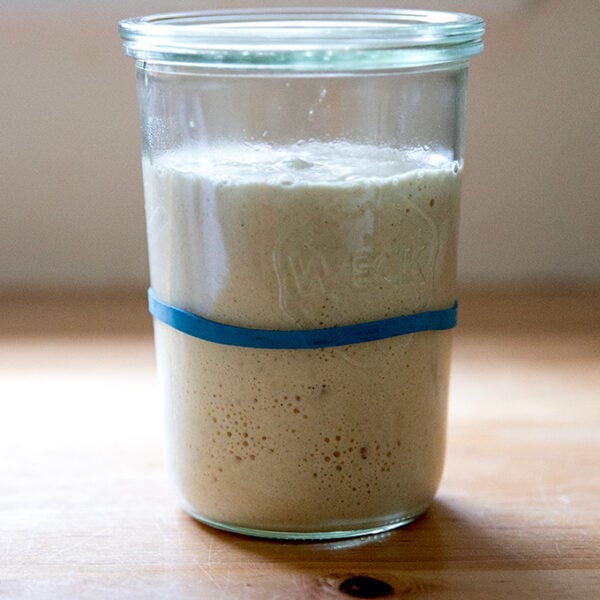
- Day 5: At this point, you should be observing some activity in your starter, meaning the starter should have risen slightly (perhaps doubled but perhaps not) and fallen with bubbles transforming from big to small. You’ll now take a small portion of this mixture and build a new starter: Transfer 100 grams of the starter to a new jar or vessel, and add 100 grams of flour and 100 grams of water. Stir well to combine, then cover the jar. Mark the height with a rubber band. Let it sit in a cozy spot. Transfer the remaining starter to the fridge — this original mixture is now your sourdough discard and can be used in all sorts of recipes, see notes above. When your new starter doubles in volume, you can do one of three things:
- Repeat this process: spoon 100 grams of starter into a new vessel and add 100 grams each of flour and water. (Transfer the remaining starter to your bucket of discard.) Let the new starter rise in a cozy spot until it doubles. Your starter will get stronger with every feeding.
- Transfer it to the fridge if you need to take a break from the process. You can pick up where you left off when you are ready.
- Test it out in a sourdough bread recipe.
- Maintaining your starter: Once you have a strong, active starter on your hands, follow the steps in this post: How to Feed, Store, and Maintain a Sourdough Starter.
- Category: Bread
- Method: Stir
- Cuisine: American