 →
→ 

Homemade Sourdough Bread, Step by Step
 By Alexandra Stafford
—
Last Updated: 03/17/2026
By Alexandra Stafford
—
Last Updated: 03/17/2026
This post may contain affiliate links. Please read my disclosure policy.
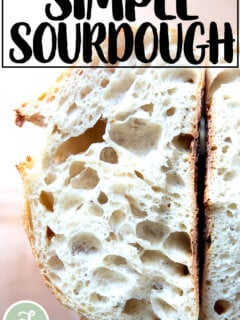
If you love fresh sourdough bread with a golden, crisp crust and a light, airy crumb, this recipe is for you. It’s one of the simplest homemade sourdough bread recipes, and one of the best, too. It requires only 25 minutes of hands-on work and no autolyse or preferment. Below you will find guidance for every step of the way. 🍞🍞
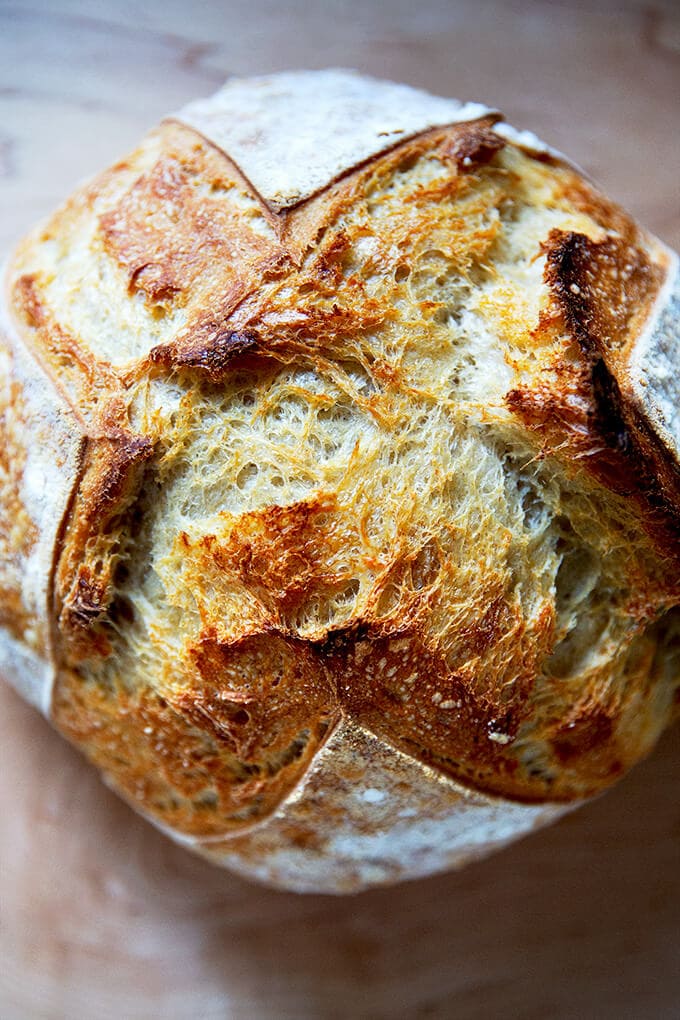
This post will show you how to make the simplest of simple sourdough breads. There is no autolyse or preferment, which means the dough itself comes together in less than five minutes.
For those intimidated by sourdough bread baking, this recipe, as well as this sourdough focaccia recipe, are the recipes I suggest making first, both for their simplicity and flavor. Another great beginner’s bread recipe to try is this overnight, refrigerator focaccia or my mother’s simple peasant bread recipe, both of which require minimal effort but yield spectacular results.
This post is divided into 13 sections:
- What is Sourdough Bread?
- What is a Sourdough Starter?
- How to Feed a Sourdough Starter
- When is My Starter Ready to Be Used?
- Equipment
- How to Make Sourdough Bread: A 5-Step Overview
- How this Sourdough Bread Recipe Differs From Others
- Simple Sourdough Bread: A Step-by-Step Guide
- #1 Sourdough Bread Baking Tip
- Troubleshooting: Where Sourdough Goes Wrong
- Sourdough Baking Resources
- Other Sourdough Bread Recipes to Make
- Sourdough Bread Baking Schedule
What is Sourdough Bread?
Sourdough bread is bread that has been leavened naturally, meaning it has been leavened by a sourdough starter as opposed to by commercial yeast or a chemical leavening agent such as baking powder or baking soda.
What is a Sourdough Starter?
A sourdough starter is a fermented mix of flour and water containing wild yeast and bacteria (lactobacilli). Provided it is healthy and active, a sourdough starter is what will make your bread rise.
You can make a sourdough starter from scratch in just about a week. I only recommend doing so if it currently is summer (or a very warm fall) where you are. While it is immensely satisfying to build a starter from scratch and subsequently use it to make a beautiful loaf of bread, I am a huge proponent of purchasing one for a few reasons, namely: when you purchase a starter, you are guaranteed to have a strong, vigorous starter from the start. In other words, you can start baking with confidence right away.
Here are two online sources for reasonably priced sourdough starters:
How to Feed a Sourdough Starter
In order to keep your starter alive, you have to feed it — it’s not unlike having a pet, but know this: caring for a sourdough starter is akin to caring for a very low maintenance pet, one that requires feeding only once every two to three weeks to stay alive, but one that requires feeding much more regularly if you like to bake frequently.
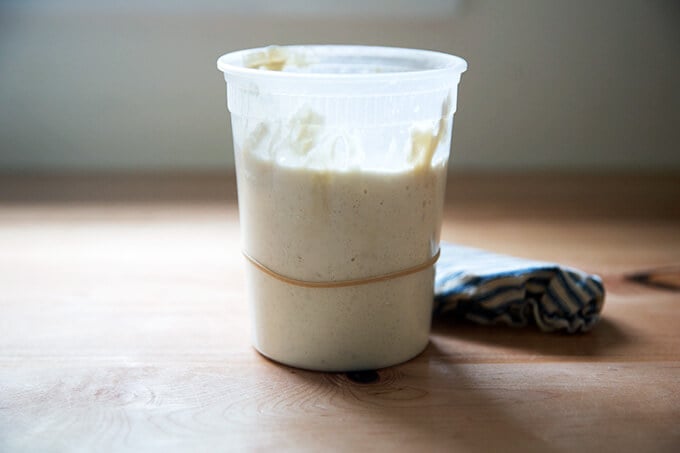
When I am not baking regularly, I store my starter in the fridge in the above-pictured vessel with its lid on. As noted above, it can hang out there for 2-3 weeks (if not longer) without being touched. To wake it up or activate it, I like to feed it twice before using it. Often, I’ll remove it from the fridge after dinner and feed it: this involves discarding most of it (down to a few tablespoons or 50 grams) and replenishing it with equal parts by weight flour and water. (Please read this post, which explains in detail how to activate, feed, and maintain a starter.)
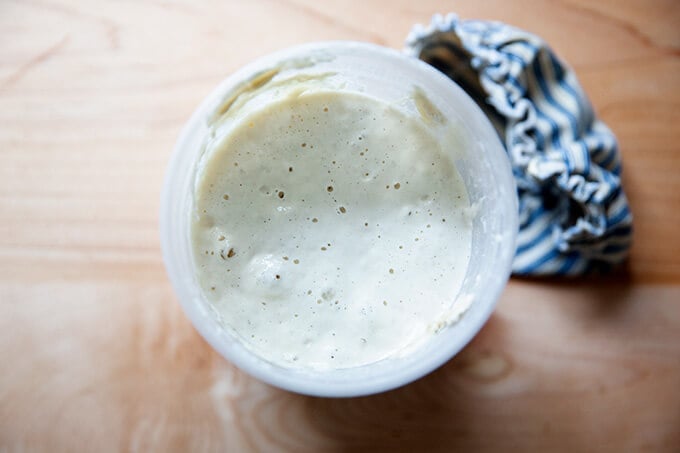
I will repeat this process in the morning: discard most of it, then replenish it with equal parts by weight flour and water. By midday, or when my starter has doubled in volume, it is ready to be used.
To store your starter, you should feed it, let it rise till it nearly doubles, then cover it and stash it in the fridge for 2 to 3 weeks until you are ready to use it again.
How Do I Know if My Starter is Ready to be Used?
If your starter doubles (or triples!) in volume within 4 to 8 hours after a feeding, it is ready to go. And ideally, you want to use your starter 4 to 8 hours after you feed it or when it has doubled. Every time I feed my starter, I place a rubber band around the vessel to mark its height. This helps me see when it has doubled in volume and is, therefore, ready to be used.
If your starter is not doubling within 4 to 8 hours of feeding it, you should spend a few days strengthening it. This will involve discarding most of it — truly, don’t be afraid to be aggressive with how much you are discarding — and replenishing it with equal parts by weight flour and water. If you do this twice a day for several days, your starter will be in great shape.
What Equipment Do I Need?
At a minimum, you’ll need:
- a sourdough starter (see above)
- flour, bread flour if possible, my preference is King Arthur Flour
- salt
- water
Ideally, you’ll also have:
- digital scale
- straight-sided vessel for monitoring the bulk fementation
- bench scraper
- flour sack towels
- parchment paper
- banneton, such as this one or this one
- razor blade
- heavy lidded vessel, such as this one or this one
What is the Best Dutch Oven for Sourdough Bread?
I love my Lodge Pre-Seasoned Cast Iron Double Dutch Oven, which I’ve had for years! The Lodge is a great value at around $49, but if you like the idea of making batards, baguettes and other oblong-shaped loaves, I can’t recommend the Challenger Bread Pan enough, which costs $299. The placement of the handles makes for easy removal and closure of the lid, and it creates beautiful, crusty loaves every time.
How to Make Sourdough Bread: A 5-Step Overview
There are essentially 5 steps to making sourdough bread. Each of these steps is explained in more detail below.
- Mix the Dough: This is simply a matter of combining water, sourdough starter, salt and flour in bowl, and stirring to form a sticky dough ball.
- Bulk Fermentation: This is just a fancy name for the first rise. During the first two hours of the bulk fermentation, you’ll perform a series of stretches and folds, which will give the dough strength and elasticity.
- Shape + Bench Rest: This step ends the bulk fermentation. You’ll shape the dough, let it rest, then shape it once more.
- Proofing the Dough: In this recipe, you’ll cold proof the dough in the fridge, ideally for 24 to 48 hours, though you can get away with a shorter proof.
- Scoring + Baking the Dough: After the dough has proofed, you’ll turn it out onto a piece of parchment paper, score it; then transfer it to a preheated baking vessel.
How This Sourdough Bread Recipe Differs From Others
This recipe differs from others in three main ways:
- No Autolyse. Why? I’ve never found employing an autolyse makes a big difference in the final texture of the bread, and I find the process of doing an autoylse frankly to be kind of a pain. What is an autolyse? Autolyse is a technique that calls for mixing flour and water together and allowing them to sit for several hours before adding the salt and sourdough starter. This process allows gluten to develop in dough prior to mixing. It also makes the dough more extensible. This is due to the hydrating effects of soaking the flour, as well as — and this is getting a bit scientific — from the enzymatic activity of protease, which breaks down some of the gluten that forms as the dough hydrates. This process weakens the dough’s elasticity, in turn increasing its extensibility. If you are after a super open crumb, autolyse is something to consider.
- 50% (roughly) Increase in Volume. If you come from the yeast-leavened bread world, you are accustomed to letting your dough double in volume during the first rise. When I first got into sourdough, I was applying this same method, and while I had success, I realized I was often letting my dough overferment — I was pushing the bulk fermentation too far. As soon as I stopped the bulk fermentation when the dough increased by 50-75% in volume, I got a much better oven spring.
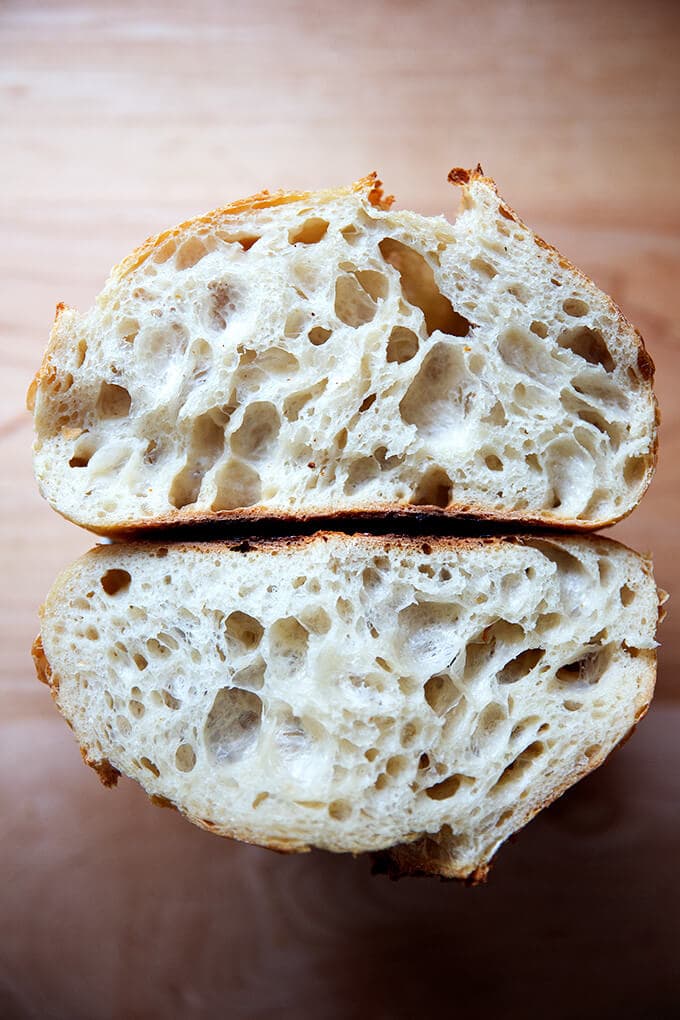
- Long Cold Proof. After the bulk fermentation, you’ll shape the dough, and store it in the fridge ideally for 24 hours but it can hang out there for 48 hours or even a bit longer. This long, cold proof will make for a much lighter, open, airy crumb. (Note: If you were to leave the dough in the fridge for 12 hours or less, which you can do, the crumb will be tighter and denser.) After you remove the dough from the fridge, you score it, and transfer it immediately to the oven — there is no need to do a room temperature proof first.
Simple Sourdough Bread: A Step-by-Step Guide
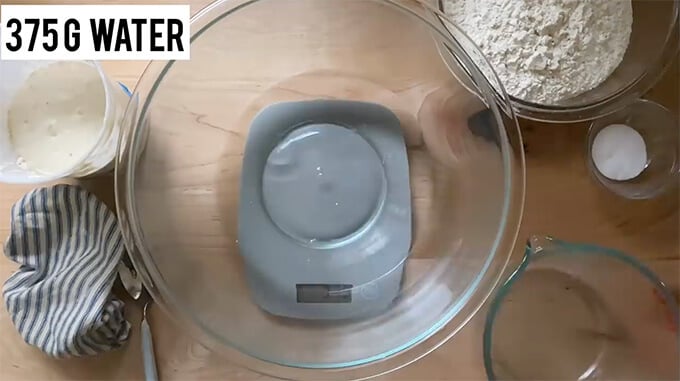
To start, pour 375 grams of water into a bowl:
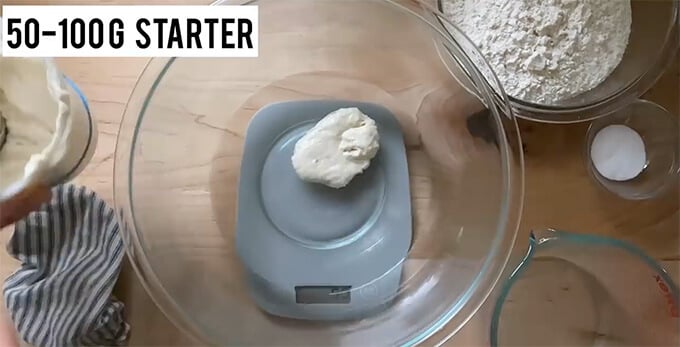
Add 50 to 100 grams of sourdough starter.
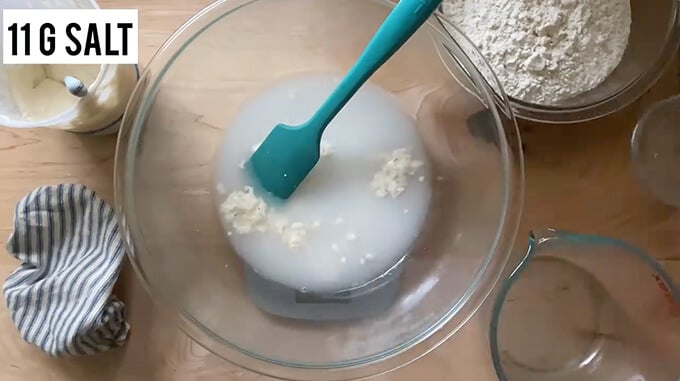
Stir to combine; then add 11 grams of salt:
Finally, add 500 grams of bread flour:
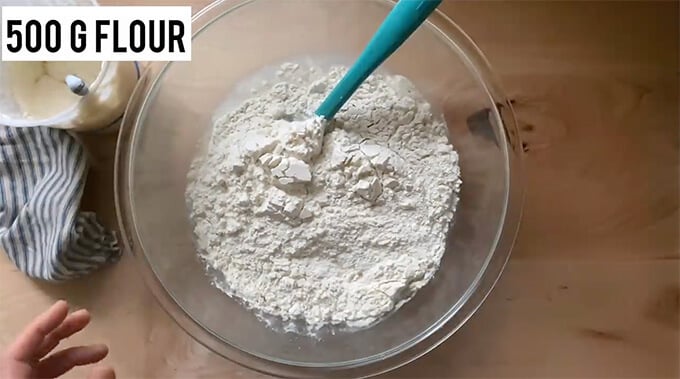
Stir to combine:
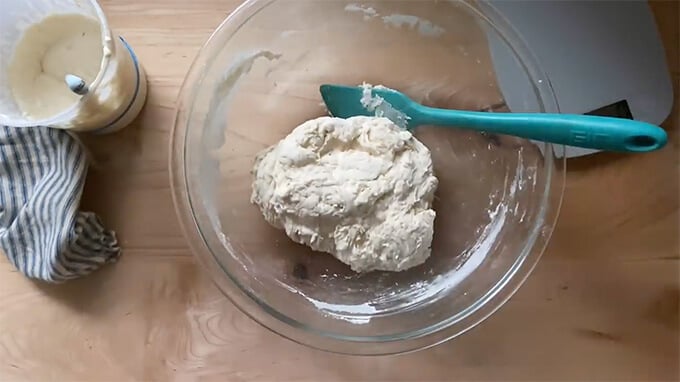
Transfer the dough to a straight-sided vessel. Cover it, and let it rest for 30 minutes.
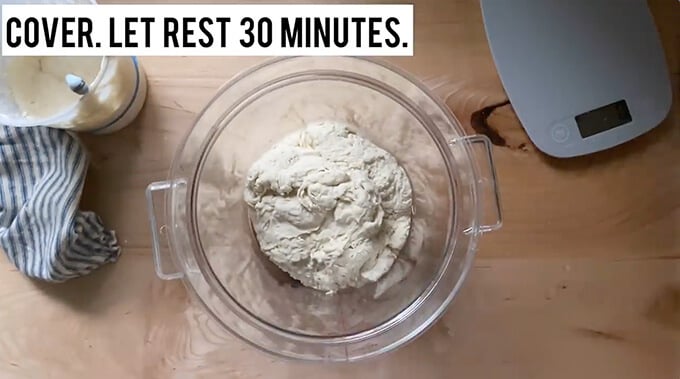
Perform a set of stretches and folds:
If time permits, perform four total sets of stretches and folds every 30 minutes for the first 2 hours. You should notice the dough getting stronger and more elastic with every set of stretches and folds. This is the 4th set:
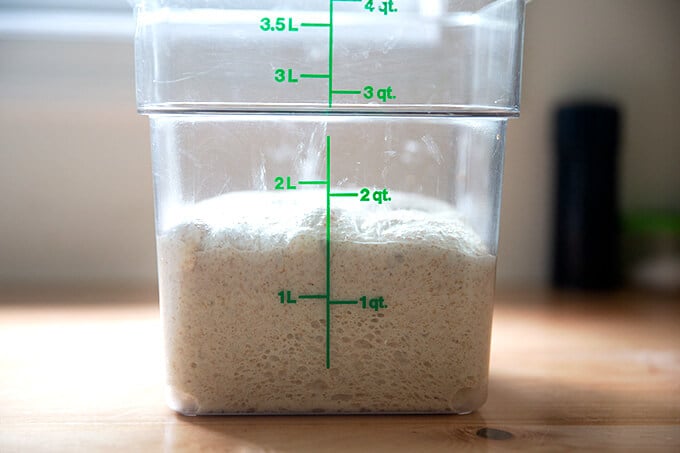
After the 4th set of stretches and folds, cover the vessel, and set it aside until it increases in volume by 50%-75%.
The time will vary depending primarily on the strength of your starter and the temperature of your kitchen. Rather than rely on a time period, however, you should rely on visual cues.
This video shows the dough nearly doubling (increasing by 100%) in volume, but the more I bake sourdough, the more I realize I have better success when I stop the bulk fermentation when the dough increases by 50%-75%. It may take some trial and error to know what works best for you. You may find a 75% increase in volume is best or you may find that to be too long. Sourdough is all about experimenting and adapting based on your experiences.
Turn the dough out onto a lightly floured work surface:
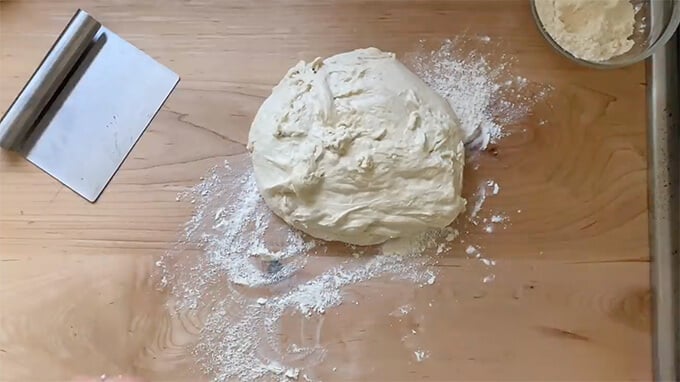
Shape the dough gently into a round and let it rest for 20-40 minutes. This is called the bench rest.
Meanwhile, prepare a bowl or banneton with a flour sack towel and rice flour.
Shape the round again; then place in prepared bowl for proofing. Transfer to fridge for 12 to 48 hours.
Remove bowl from fridge, and turn it out onto a sheet of parchment paper.
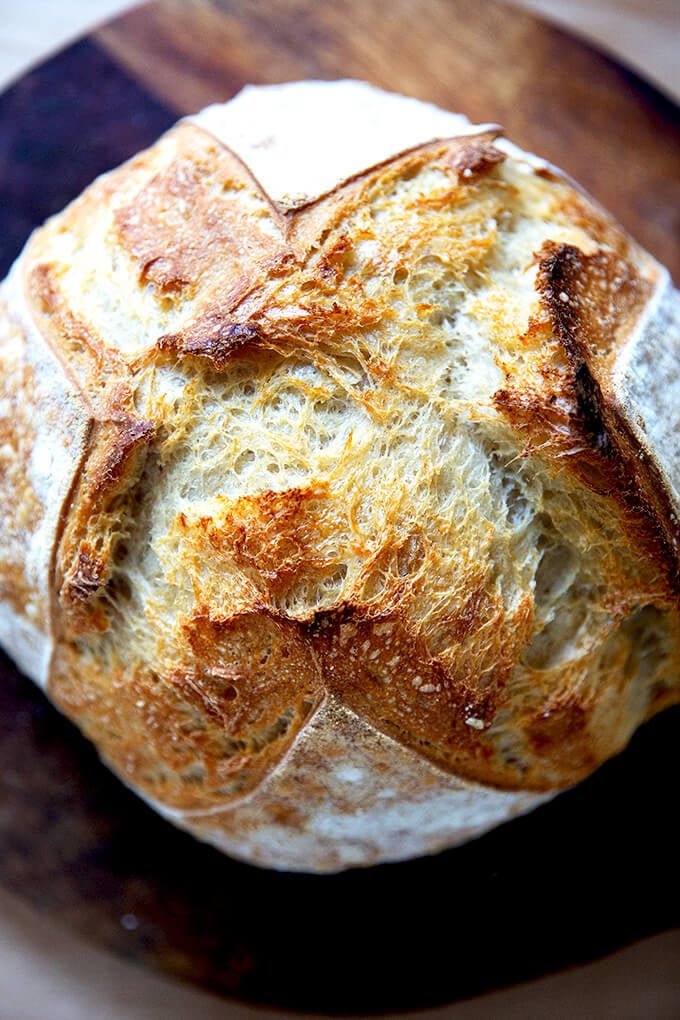
Score it.
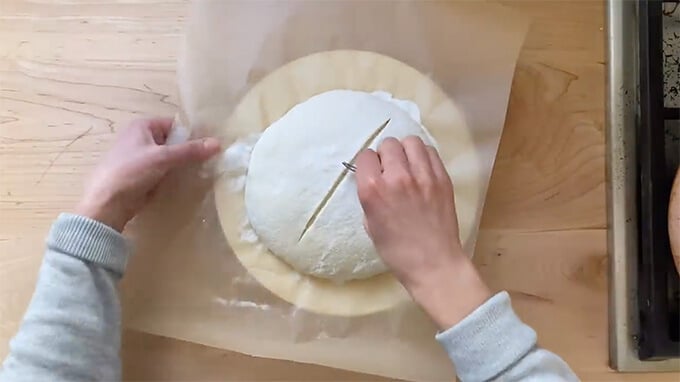
Transfer to preheated Dutch oven. Bake covered at 450ºF for 30 minutes; uncover, lower the temperature to 400ºF, and bake for 15 minutes more:
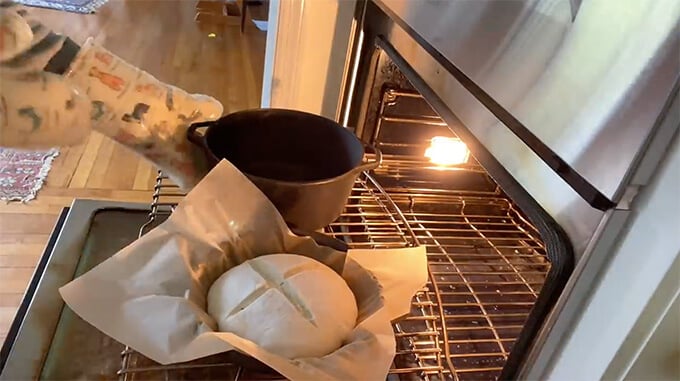
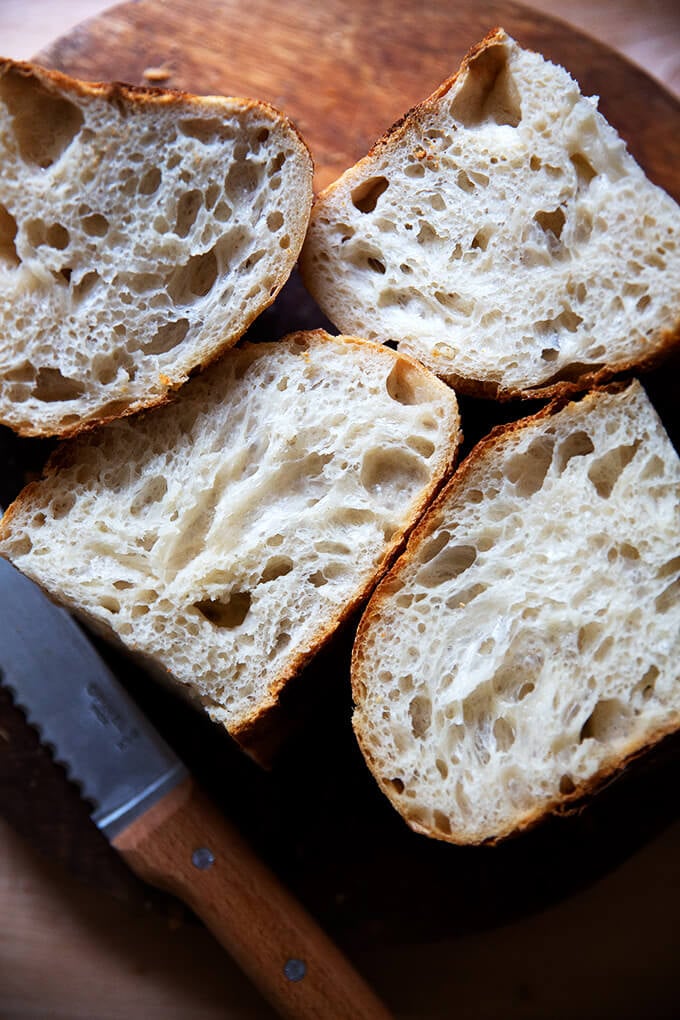
Remove from oven and let cool one hour before slicing.
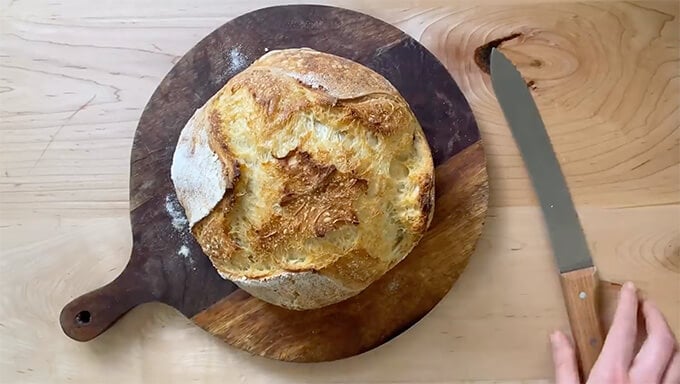
You’ll need a sharp knife (like this one or this one) when it’s time to slice:
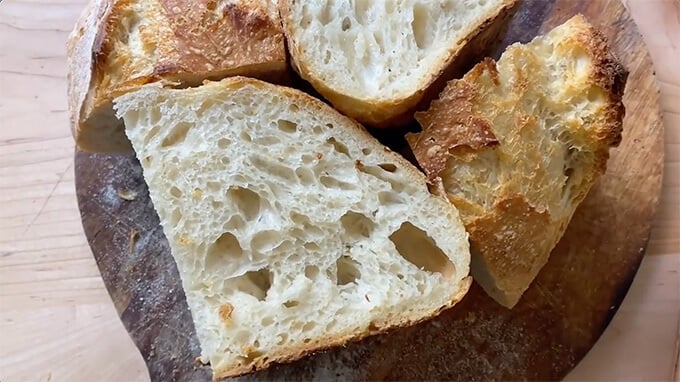
#1 Sourdough Bread Baking Tip
The refrigerator is your friend. Use it.
The most common mistake I see people make when making sourdough bread is letting the bulk fermentation go too long. They mix the dough at night; then wake up to dough that has tripled in volume and is a sticky mess.
To prevent over-fermenting your dough, use your refrigerator as needed. After you complete the 4 sets of stretches and folds, you can put your dough in the fridge at any time. If you are tired and need to go to bed, transfer the dough to the refrigerator; then pick up where you left off in the morning: remove the dough from the fridge and let it continue to rise until it increases in volume by roughly 50%.
To accurately gauge when your dough has risen to roughly 50% in volume, I highly recommend investing in a straight-sided vessel such as this 4-qt Cambro (or this one, which is BPA-free!). When dough rises in a bowl, judging when it has risen sufficiently is tricky. There’s no question with a straight-sided vessel.
Troubleshooting: Where Sourdough Goes Wrong?
If you have ever had trouble baking sourdough bread, your issues likely stem from one of four places:
- Using a weak starter or not using starter at its peak.
- Using too much water relative to the flour.
- Over fermentation: letting the bulk fermentation (first rise) go too long.
- Using too much whole wheat flour, rye flour, or freshly milled flour.
I address each of these issues in this post: Why is my sourdough so sticky? 4 Common Mistakes, so please give it a read if you’ve had trouble with sourdough bread baking.
Sourdough Resources
- Sourdough Troubleshooting: This post addresses 4 common mistakes people make when baking sourdough bread and answers many FAQ’s as well.
- The Nutritional Benefits of Sourdough Bread + 6 Healthy Toast Topping Ideas
- Feeding Your Sourdough Starter
- Essential Equipment For Sourdough Bread Baking
- A tip for getting a more open crumb? Shape a batard as opposed to a round:
Other Sourdough Bread Recipes to Make
- Simple Sourdough Focaccia
- Sourdough Bread, Whole Wheat-ish
- Simple Sourdough Pizza
- Simple Sourdough Sandwich (or Toasting) Bread
- Sourdough Ciabatta
- Sourdough Discard Recipes
Sourdough Bread Baking Schedule
If you are new to sourdough bread baking, the timing of it all may feel overwhelming — you may find yourself asking: How can I do this without baking at midnight?
It’s a very good question! As noted above, your biggest friend when it comes to sourdough bread baking is your refrigerator. If after you’ve performed your stretches and folds, you don’t have time to stay up for the dough to complete the bulk fermentation, stick the vessel in the fridge and pick up where you left off the next day or the day after that.
Here is a rough schedule I like to follow. Adapt it to work for you:
Wednesday Evening: Remove starter from fridge. Feed it by discarding most of it and replenishing it with equal parts by weight flour and water.
Thursday Morning: Feed starter by discarding most of it and replenishing it with equal parts by weight flour and water.
Thursday Afternoon: Mix dough, let it rise. On Thursday evening, when the dough has completed the bulk fermentation, I’ll shape it and stick it in the fridge to proof. (As noted: If the dough hasn’t completed the bulk fermentation, I’ll stick the vessel in the fridge, and pick up where I left off the following day.)
Friday Evening or Saturday Morning: Score and Bake it. There is no need to let the dough come to room temperature before baking it. Simply remove it from the fridge, turn it out, score it, and bake it!
Print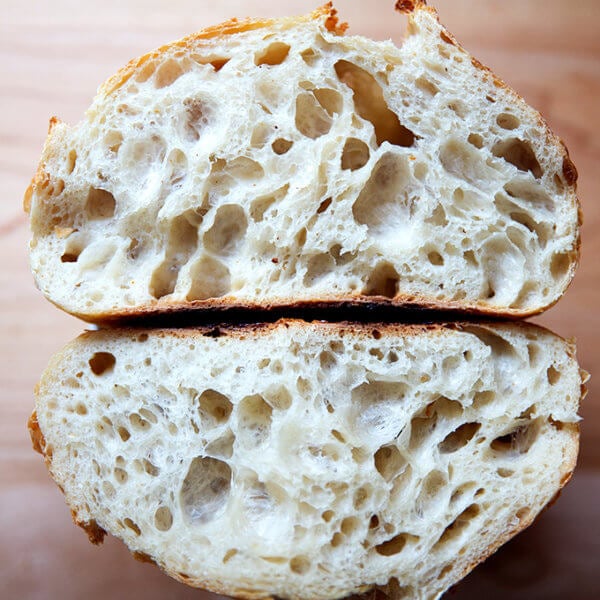
Homemade Sourdough Bread, Step by Step
- Total Time: 18 hours 45 minutes
- Yield: 1 loaf 1x
Description
If you love fresh sourdough bread with a golden, crisp crust and a light, airy crumb, this recipe is for you. It’s one of the simplest homemade sourdough bread recipes, and one of the best, too. It requires only 25 minutes of hands-on work and no autolyse or preferment. Below you will find guidance for every step of the way. 🍞🍞🍞
Inspired by The Clever Carrot
If you are new to sourdough, watch the step-by-step video here: Simple Sourdough Bread or in the post above.
Troubleshooting: If you have issues with your dough being too sticky, please read this post: Why is my sourdough so sticky? The 4 common mistakes.
Notes:
- You need an active sourdough starter. I have had success activating starters from:
- As always, I highly recommend investing in a digital scale before beginning any bread baking adventure.
- This is the Dutch Oven I use for sourdough bread. I used this Dutch oven for years, and it’s a great one, too.
- Flour sack towels are a great investment because they ensure your dough will not stick while it is proofing.
- I love using rice flour for dusting (as opposed to ap or bread flour) because it doesn’t burn. When you use a flour sack towel, however, you don’t need to use any flour.
- Find all of my sourdough essentials here: Essential Equipment For Sourdough Bread Baking
- I love a high-hydration dough, and I have great success using 380 grams of water in this recipe, so feel free to play around and push the hydration here.
- Salt: I have had success using both kosher salt and fine sea salt here. When I use kosher salt, I use the Diamond Crystal brand. When I use sea salt, I use the Baleine Fine brand. Regardless of the brand, I use 12 grams.
- Shaping: If you’re looking to get a more open crumb, try shaping a batard (as opposed to a round). Watch this video for guidance. Also: The recipe below follows the traditional shape once, rest, then shape again method. I often skip the preshape now and simply shape the dough once. I still get a nice open crumb.
- Adding Other Ingredients: See this post on adding “inclusions”: Rosemary-Olive Sourdough Bread (+ A Better Way to Add Inclusions to Your Sourdough Bread)
How much Sourdough Starter to Use?
- Because my kitchen is cold for much of the year, I like using 100 g (1/2 cup) of starter as opposed to 50 g (1/4 cup). When determining how much starter to use, consider a few things: If you live in a warm, humid environment, 50 g should suffice. If you plan on doing an overnight rise, 50 g also should suffice. If you want to speed things up or if you live in a cold environment, consider using 100 g starter. Note: If you use 100 g of starter, your dough may rise more quickly, so keep an eye on it. As always, rely on the visual cues (increasing in volume by 50%) when determining when the bulk fermentation is done.
- A straight-sided vessel makes monitoring the bulk fermentation especially easy because it allows you to see when your dough has truly doubled.
Ingredients
- 50 – 100 g (1⁄4 – 1/2 cup) bubbly, active starter — I always use 100 grams, see notes above
- 375 g (1 1/2 cups plus 1 tbsp) warm water, or more, see notes above
- 500 g (4 cups plus 2 tbsp) bread flour
- 9 to 12 g (1.5 – 2.5 teaspoons) fine sea salt, see notes above
Instructions
- Make the dough: Whisk the starter and water together in a large bowl with a fork or spatula. Add the flour and salt. Mix to combine, finishing by hand if necessary to form a rough dough. Cover with a damp towel and let rest for 30 minutes.
- Stretch and fold: After 30 minutes, grab a corner of the dough and pull it up and into the center. Repeat until you’ve performed this series of folds 4 to 5 times with the dough. Let dough rest for another 30 minutes and repeat the stretching and folding action. If you have the time: do this twice more for a total of 4 times in 2 hours. Note: Even if you can only perform one series of stretches and folds, your dough will benefit. So don’t worry if you have to run off shortly after you mix the dough.
- Bulk Fermentation (first rise): Cover the bowl with a damp towel or, ideally, a lid or something that will create an airtight seal to prevent the dough from drying out. Let the dough rise at room temperature, about 8 to 10 hours at 70°F (21°C) or even less if you live in a warm environment. The dough is ready when it has increased by 50-75% in volume, has a few bubbles on the surface, and jiggles when you move the bowl from side to side. (UPDATE: In the past I have recommended letting the dough rise until it doubles in volume. If you’ve had success with this, continue to let the dough double. Recently, I have been stopping the bulk fermentation when the dough increases by 50% in volume, and I feel I am actually getting better oven spring in the end.) (Note regarding timing: If you are using 100 g of starter, the bulk fermentation may take less than 8 to 10 hours. If you live in a warm, humid environment, the bulk fermentation may take even less time. In the late spring/early summer, for example, my kitchen is 78ºF and the bulk fermentation takes 6 hours. It is best to rely on visual cues (increase in volume by roughly 50%) as opposed to time to determine when the bulk fermentation is done. A straight-sided vessel makes monitoring the bulk fermentation especially easy because it allows you to see when your dough has truly increased in volume by 50%.)
- Shape (See notes above): Coax the dough onto a lightly floured surface. Gently shape it into a round: fold the top down to the center, turn the dough, fold the top down to the center, turn the dough; repeat until you’ve come full circle. If you have a bench scraper, use it to push and pull the dough to create tension.
- Rest: Let the dough rest seam side up rest for 30 minutes. Meanwhile, line an 8-inch (20-cm) bowl or proofing basket with a towel (flour sack towels are ideal) and dust with flour (preferably rice flour, which doesn’t burn the way all-purpose flour does). Using a bench scraper or your hands, shape it again as described in step 4. Place the round into your lined bowl, seam side up.
- Proof (second rise): Cover the dough and refrigerate for 1 hour or for as long as 48 hours. (Note: I prefer to let this dough proof for at least 24 hours prior to baking. See video for the difference in the crumb of a loaf that has proofed for 6 hours vs one that has proofed for 24 hours. If you choose to proof the dough in the fridge for an extended period of time, you may want to tuck it into a loosely tied bag — produce bags from the grocery store are great for this purpose — to ensure the dough does not dry out. The original recipe calls for a 1-hour rise, and if you have had success doing that, by all means, keep doing it.)
- Place a Dutch oven in your oven, and preheat your oven to 550°F (290°C). Cut a piece of parchment to fit the size of your baking pot.
- Score: Place the parchment over the dough and invert the bowl to release. Using the tip of a small knife or a razor blade, score the dough however you wish — a simple “X” is nice. Use the parchment to carefully transfer the dough into the preheated baking pot.
- Bake: Lower the oven to temperature to 450ºF (230ºC). Carefully cover the pot. Bake the dough for 30 minutes, covered. Remove the lid, lower the temperature to 400ºF (200ºC) and continue to bake for 10 – 15 minutes more. If necessary, lift the loaf out of the pot, and bake directly on the oven rack for the last 5 to 10 minutes. Cool on a wire rack for 1 hour before slicing.
- This loaf will stay fresh up to 3 days stored at room temperature in an airtight plastic bag or container. It freezes beautifully, too.
Notes
- This recipe has been adapted from Artisan Sourdough Made Simple. Changes I have made to the original recipe include:
- Using 11 g salt as opposed to 9 g.
- Performing 4 stretch and folds during the first 2 hours of the bulk fermentation, which build strength in the dough.
- Doing a cold proof for at least 24 hours before baking, which produces a lighter airier crumb. In the video, you can see the difference between the crumb of a loaf that has proofed for only 6 hours vs a loaf that has proofed for 24 hours.
- Finally, I like preheating my Dutch oven, which makes a crisper crust.
- Prep Time: 18 hours
- Cook Time: 45 minutes
- Category: Bread
- Method: Oven
- Cuisine: American
This post may contain affiliate links. Please read my disclosure policy.














6,024 Comments on “Homemade Sourdough Bread, Step by Step”
My first time making sourdough and this recipe turned out perfect!! I was so surprised it tasted like it was from a French bakery
Great to hear, Elizabeth! Thanks so much for writing and sharing this 🙂
My dough always ends up too wet and doesn’t hold it’s shape. Any suggestions? I’ve tried using less starter, less water, and adding extra flour in separate batches.
Hi! Are you using a scale to measure? What type of flour (brand included) are you using? Where are you located (as in what part of the country or abroad)?
I have used your recipe in the past and it came out great. If I want to freeze my dough, at what point would I do that?
Great to hear, Brooke! I actually would not recommend freezing sourdough dough… it loses a bit of its oomph and doesn’t bake up as well. The baked loaf freezes beautifully.
Can I use this recipe for my inclusions loaf
Hi! I have a post on how to add “inclusions” to sourdough: Rosemary-Olive Sourdough Bread (+ A Better Way to Add Inclusions to Your Sourdough Bread)
I make this almost every week! Perfect! 🙂
Great to hear, Tina 🙂 Thanks so much for writing.
Tried this recipe for the first time and loved it! I have always made a levain for sour dough bakes, and I was curious to see how this compared. The end result was wonderful; great rise resulting in a soft/airy/chewy crumb and a beautifully crisp crust replete with blisters. This recipe came together so quickly without the levain process, and the bulk rise only took 2.5 hours-that I found shocking! Thanks so much for this, Ali, it is a great, user friendly recipe and I am making a four loaf batch as I type this!
Amazing! Mark, it’s so nice to read this. Your starter must be very happy/vigorous. Thanks so much for writing and sharing your experience. I’m so happy to hear about the 4-loaf batch 🙂
Hi there…just wondering why the loaf flattens after overnight proof? I followed the recipe exactly with 100g starter.
Thank you
Connie
Hi Connie… are you referring to the fridge proof?
How long was the bulk fermentation?
Did you use a straight-sided vessel for the bulk fermentation?
Are you using a scale to measure?
What type of flour?
I am so psyched!!! I have been trying for years to get sourdough right. I created my own starter and used this recipe, and it worked!! Thank you for publishing it. I would recommend this procedure to anyone!
Great to hear, Jodi! Thanks so much for writing and sharing this 🙂
I used this recipe for my first time ever making sourdough. It turned out amazing! Wonderfully written and easy to follow. Now everybody I know is asking for a loaf lol!
Great to hear, Beth! Thanks for writing and sharing this 🙂
Great recipe and super helpful tutorial. The descriptive instructions and videos make baking sourdough easy for everyone. The sourdough loaf turns out great every time and is super delicious!
Great to hear, Laurie! Thanks so much for writing 🙂
Is there any point where I can put this in the fridge and continue tomorrow? Like preferably after the stretch and fold section before the first rise?
Yep! You can use the fridge any time during the bulk fermentation 🙂
I am a “beginning” sour dough bread baker and love this recipe. It hasn’t ever failed to give a good loaf, but am having trouble getting it totally baked—-I am at 5300 ft altitude and internal temp can’t ever quite get to 200 degrees. Highest temp has been 199. It still is very good, especially toasted. But I see that you say “you may want to take it out of the dutch oven for the last 5-10 minutes.” Would this help? I wonder why you suggest that.
Thanks so much!!
Hi! Great to hear. Removing it from the Dutch oven is for people who find the bottom crust gets a little too tough/crisp. When you remove it from the DO, you can place it on a sheet pan, which will allow it to continue to cook but will prevent the bottom crust from getting overdone. This might help you as well.
Does the crumb seem damp or excessively moist? Are you letting it cool for at least an hour before cutting it?
If you are happy with the crumb, I wouldn’t worry too much about what the temperature reads.
My friend gave me some starter and I was so overwhelmed as what to do. I turned to your recipe and the bread turned out beautifuly. Thank you so much for sharing.
Great to hear, Dominika! Thanks so much for writing and sharing this 🙂
Thank you for sharing this! So much simpler than other recipes. My question is whether you use a dry towel for the bulk fermentation. I let mine rise for about 10 hours with a dry towel and a crust or skin had developed on the top. I only used the towel because I was following the recipe. I usually use a silicone cover that is airtight. Should I be using a wet towel instead or my silicone cover or something else? I have also made bread that suggests spraying the top of the dough with an oil spray before bulk fermentation. I’d love to hear whether this has happened to you and, if so, what you have used instead of the dry towel.
Hi! I need to update the recipe … a silicone cover is great or anything else that is airtight. I use a bowl with a lid for the first two hours when I am stretching and folding, then I transfer the dough to a straight-sided vessel for the bulk fermentation which has a lid. It’s a real bummer when a crust forms, and I’m sorry this happened!
Thank you – giving it another go now!
Similar situation here- I wasn’t sure if a wet or dry towel should be used in the fermation phase (used dry) then when I came to check on it no bubbles and crust formed on dough. Wah! My daughter and I will try again when time allows. Thanks for putting your recipe online and answering questions!
Shoot! I just updated the post noting to use a lid or any cover that will create an airtight seal. Apologies you experienced the same crust on the dough… no fun. I hope your next attempts are more successful!
Thanks! We made it anyway and it was still very good! Will try again with the airtight seal. Your specific directions and photos are incredibly helpful to novices like me!
Oh good, I’m happy to hear this. I have had success simply incorporating the crusted section back into the dough… it eventually dissolves, but again, it’s just not ideal. Thank you for your kind words 🙂
I’ve been using your recipe for a while now as a basis and have been saying around with it to suit what I like. Here is what I do if anyone is interested.
I 1.5x times the recipe:
150 GR active starter (peak)
560 GR water
20 GR salt
Stir thoroughly
375 Plain flower
375 wholemeal
I also add about 1.5 cups worth of different seeds in the last stretch and fold (sunflower, flax, quinoa, pepita).
The rat of the steps are the same, except for baking. I do 50min at 260°C with lid on Dutch oven (preheated) and then 4 extra minutes lid off.
Hope you’ll have fun trying this out!
Thanks for sharing these notes, Stephan! I love a seedy bread. Will definitely try that mix 🙂
Your tip to shaping the dough differently (envelope then roll) has been a game changer. I’m now getting the open yet chewy crumb I’ve been searching for. Thank you x a million!!
I’m so happy to hear this, Fran! Thanks so much for writing and sharing this 🙂
This recipe was absolutely perfect. I’ve been in love with your sourdough foccacia recipe for a while now but was always a bit intimidated by making a loaf. Finally took a stab at it and it came out perfect first try. The long cold proof ends up making it pretty convenient and flexible to work with, I ended up going for 36ish hours. I found the whole process surprisingly forgiving for a beginner. This will be the recipe I come back to for a long time — thank you Ali!!
Great to read all of this, Zach! I’m so glad that you appreciate how the cold proof gives you more flexibility — so many people wonder how they can make the sourdough timeline work for their schedule, which I totally get bc it’s overwhelming at first, but once you get the hang of it, sourdough actually gives you more flexibility than yeast bread bc you bake it on demand straight from the fridge. Anyway! Thanks for writing 🙂
I had high hopes for trying this recipe for the first time due to all the rave reviews, but it didn’t work out for me. I’m new to sourdough baking, so I am sure the issue was from something on my end. I followed the recipe to the “t,” weighing all my ingredients and using a straight-sided food prep container to ensure my dough bulked to 50%. It had bubbles on the top and jiggled as it was supposed to, but when I went to shape it, it felt a bit wet and turned into a blob and wouldn’t hold tension. I still gave it a go and let it proof in the refrigerator (12 hrs). Unfortunately, it barely had any oven spring and the crumb looked underfermented. I’m at a higher altitude, above 5600ft, so I don’t know if I need to adjust something on my end. My starter is immature, but has been strong from the start as I have been able to get some decent loaves from it already, so I am not sure if it was the issue. Hopefully, the next time I try this recipe, I will get better results.
Hi Rachel,
Bummer to hear this. Your dough definitely over fermented during the bulk fermentation: “it felt a bit wet and turned into a blob and wouldn’t hold tension” = over fermented dough. Unfortunately when dough over ferments, it’s basically unsalvageable.
Your altitude could definitely be playing a role.
What type of flour (brand included) did you use?
I would suggest using 50 grams of starter next time around if you used 100 grams this time.
Regarding your starter, did you build it from scratch? Does it double in volume within 6 or so hours of a feeding?
This recipe looks amazing, I’m currently making a loaf, but it seems verrrrry wet and won’t hold its shape. I used 60 g starter with king arthur bread flour, overnight proof doubled in size but just came out flat and jiggly. Any tips? It’s currently cold proofing in the fridge but is just spreading out into a pancake again 🙁
Hi Jaina,
It sounds as though the dough overfermented during the overnight proof. And unfortunately, it likely will not bake well… when sourdough overferments it’s sort of unsalvageable. Did you use a straight-sided vessel for the bulk fermentation? Next time around, I’d shoot to end the bulk fermentation when the dough increases in volume by between 50-75%. A straight-sided vessel will really help you see how much your dough has increased in volume.
I have been trying to make sourdough without much luck but this is the first recipe that has turned out! I’m so nervous to deviate but I would like to make two smaller loaves, or even 4 loafs, from this recipe. Any suggestions on cook time adjustment when dividing the dough into smaller loaves?
Hi! Great to hear 🙂
You can divide the dough after the bulk fermentation into two (or more) portions. Proceed with the recipe as directed. When baking, reduce the baking time at each phase (covered and uncovered) by 5 minutes. But ultimately bake the loaves for as long as needed until they are browned to your liking.
Hi Ali,
Thanks for the great recipe! My bread has never been better! I do have a question – the parchment paper sticks to my bread when I take it out of the oven, and it’s quite a chore to get all the little pieces removed that are stuck – do you have any suggestions for how to avoid this? The parchment paper also gets dark brown in the oven and a little crispy, flaking off occasionally into the oven, so perhaps I’m just using a poor quality parchment paper.
Hi Erin! What brand are you using? I do think the brand makes a difference. I try to use unbleached. I like the If You Care Brand. I have had bad luck with parchment and sticking once when I bought a bulk set on Amazon… terrible sticking. It was so frustrating.
I am trying your recipe today and will want to overnight rise the dough the night before baking. Unclear if I have to bring to room temp, or let rise more before baking? As often you see very little visible rise when refrigerating.
Thank you! Good directions
Hi Ann: when you say “overnight rise,” you mean in the fridge, correct? If so, no need to bring it to room temperature before baking it. Remove it, score it, bake it 🙂
Foolproof is right! After bulk fermentation i was in the middle of a great hockey game so I threw the dough into a banneton, (no shaping or bench rest), let it sit in the fridge for a couple of days and baked it as instructed. Turned out great, just like the picture, nice tangy flavor and crispy crust. My first try and I will probably do it better next time but shoutout to PH Mills strong bakers flour.
Great to hear, Dan! Thanks for writing and sharing your notes/experience, and thanks for sharing the brand of flour, too — it’s so helpful for other bakers to know which flours work well as all flours absorb water differently, which can be frustrating for inexperienced bakers.
I have a bubbly, active starter that I feed with whole wheat flour 1/1/1. It consistently doubles or more in 4-6 hours. Can I use my starter to make this recipe with regular AP flour? I don’t always have bread flour.
Yes, that should be fine. I would use 50 grams of starter as opposed to 100 grams.
This is the recipe that yielded my first perfect sourdough cob, I’ve tried many different recipes over the last 6 months to varying degrees of success but yours is the absolute best!
I’m so happy to hear this, Mandy! Thanks so much for writing 🙂
I have been using your recipe for my sourdough bread and love it. I have been using the King Arthur flour as you recommend in the recipe. I am wanting to make gluten free sourdough now because my wife just found out she is Gluten sensitive. Have you used the KA gluten free bread flour before and can you substitute it 1:1 in your recipe? I would appreciate any help you can give!!
Hi Ralph! I have not attempted this recipe gluten free because that would entail building a gluten-free sourdough starter, which I find a little intimidating. I think you’ll have better luck using specifically a gluten-free sourdough bread recipe… there are so many bakers out there that have dedicated their lives to gf baking and will be better equipped to help should you run into any road blocks. Wish my knowledge extended to gf sourdough and that I could help more!
Thanks! I have a GF starter started from KA GF bread flour. They also have a GF recipe also.
Ralph
Oh great to know! I would stick with the KAF gluten-free recipe. I haven’t looked but I imagine there are no “stretches and folds” with gf sourdough as there is no gluten to develop? Again, I think the team of bakers at KAF will be a much better resource than I.
Just made my first sourdough loaf with this recipe and it came out great! I really appreciate all of the additional notes you have in your instructions, they’re super helpful. My starter is only about 2 months old so I didn’t quite get the rise I wanted, and I probably should’ve left it to rise a little longer the first time round, but that’s all totally on me. Also love that you include videos in your recipes, as a visual learning they are are huge help.
This recipe is super easy to follow and I love the loaf I got out of it!
Great to hear, Sorcha! Thanks so much for writing and sharing your notes/experience. Every bake will teach you something, and as your starter gets stronger, you will get even better results.
Great recipe! I loved all the step-by-step instructions, finding them clear and easy to follow. The result was a beautiful loaf of sourdough on my first try. Thank you Ali for this recipe, I will be sure to use it again!
Great to hear, Amelie! Thanks so much for writing 🙂
First time I’ve ever had such excellent luck with a sourdough recipe! I’ve seen some talk about freezing, but I have a couple of questions regarding that:
What is a good temp/time to warm the frozen loaf in the oven?
Should I wrap it in foil before then?
Do you think it would work if I par-cooked it, and then froze it, or would that take away some if its goodness?
Hi Mackenzie 🙂 Great to read this.
I suggest thawing the frozen loaf at room temperature first — you can do this the night before or for at least 2 hours before you plan on serving it. Just leave the loaf at room temperature in the bag or vessel it was frozen in. Once it is thawed, you can just set it directly on the oven racks. I reheat day-old bread @ 350F for roughly 15 minutes.
I have not had great success with parbaking and freezing, but I also have not experimented extensively on this, so you may have better success than I.
Hey Ali- I made this and it was my first sourdough, 2nd bread. I followed everything and used 100g Fletchmans starter, King Arthur bread flour. It looked awesome and and tasted wonderful, but it was dense. It just didn’t have the air pockets. Any idea what happened? Thanks for all your great recipes!
Hi Eric,
Can you tell me more about Fletchmans Starter? I am unfamiliar with that product. A few more questions:
Had your starter doubled in volume before you used it?
Did you use a straight sided vessel for the bulk fermentation? And how much did the dough increase in volume during the BF?
When you shaped the dough into a boule or batard, did the dough have strength and elasticity?
Did you cold proof it before baking?
Been making SD bread using alternative methods for a few years. The results improved with each bake. But this time I decided to follow your instructions. I fed my regular starter and set aside a 1/4 c and fed it. Next day began your process. From Friday night to Monday Noon the bake was the Best one, yet!
The bread’s structure is sound, bubbly, soft, chewy and the crust is just right! I am very happy with the results! Thank you!
Great to hear, Mick! Thanks so much for taking the time to write and share your notes/experience. Happy baking!!
I have been trying recipe after recipe for Sourdough and I have to say this is the absolute best I have found! I exactly followed the recipe and watched each of the tutorials and cold proofed my loaf for about 16 hours. It rose to a beautiful crown in the dutch oven and when I cut it for my husband and I to try I almost cried…it was so beautiful. the crust was perfect and it was light and airy and the taste was simply wonderful. This will be my go-to recipe from here on out. Thank you, Alexandra!
I’m so happy to read this, Dee! Thanks so much for writing and sharing this. Seeing a beautiful, crusty, lofty loaf in a Dutch oven never gets old 🙂
I made this recipe last weekend and it turned out amazing!!! So much so that I’m making more bread this weekend. I also read your schedule so I’m incorporating that a little to make timing work better. This time I’m doubling the recipe so I can give a loaf to my neighbors. Would you recommend splitting the dough in two after the bulk fermentation or after the proof. Or does it matter?
Thank you so much for sharing this recipe and all the information on bread making!
I’m so happy to read this, Adam. And how nice for your neighbors?!
Yes, split the dough after the bulk fermentation, then proceed with the recipe as written.